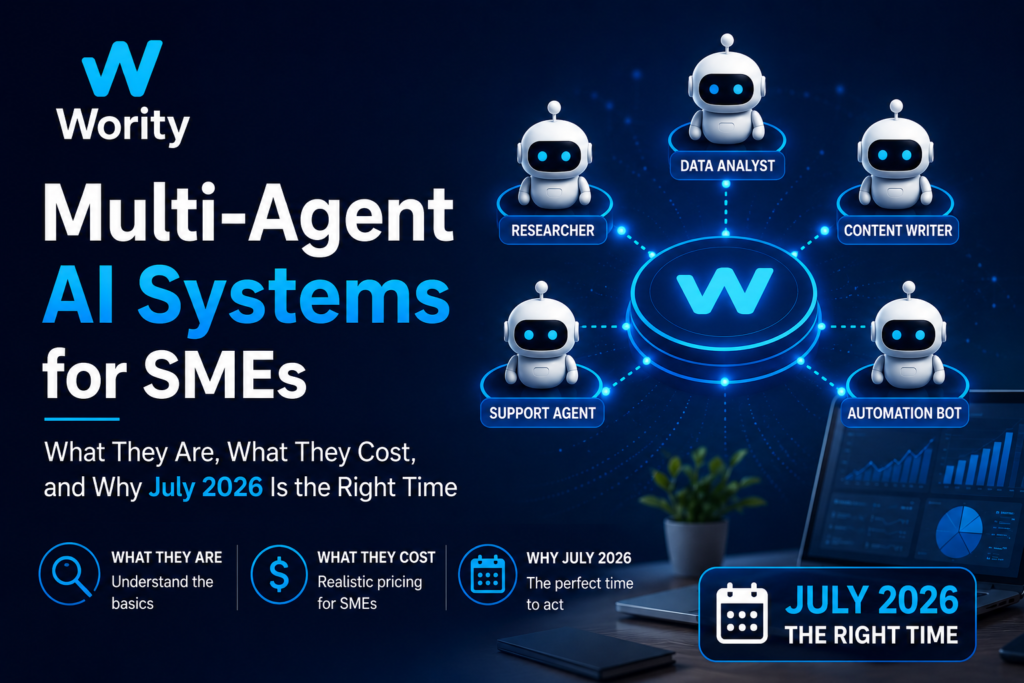
Multi-Agent AI Systems for SMEs: What They Are, What They Cost, and Why July 2026 Is the Right Time
Most small business owners hear “multi-agent AI system” and picture something designed for Amazon or JPMorgan — a room full of servers, a six-figure technology budget, and a dedicated AI engineering team to keep it running.
What they will not tell you is that a 20-person SME can deploy a production-ready agent system this week with a $30-per-month tool stack and one focused afternoon of setup time.
A three-agent AI system frees 10 to 15 hours per week within 30 days for a typical small business, at an operating cost of under $200 per month. That is not a projection. That is what independent AI automation consultants are measuring in production across SMEs in Europe, the US, and the GCC right now.
Both Forrester and Gartner identify 2026 as the breakthrough year for multi-agent systems, where specialised agents collaborate under central coordination. The timing is not coincidental. Three specific developments have converged in mid-2026 to make multi-agent AI systems genuinely accessible to small businesses for the first time: tool costs have fallen dramatically, the Model Context Protocol has created a standard for agent-to-agent communication, and the platform ecosystem now supports SME-friendly deployment without enterprise-grade infrastructure.
Gartner projects that by end of 2026, 40% of enterprise applications will include task-specific AI agents. The SMEs that deploy their first multi-agent systems in Q3 2026 will have a meaningful operational advantage over those that wait — because the operational data, workflow optimisation, and staff adoption that compound over time start accumulating from the first day of production deployment.
This guide covers everything an SME needs to make a confident, well-informed decision: what multi-agent AI systems actually are, how they differ from single agents and chatbots, the four types that deliver real ROI for small businesses, the honest cost breakdown across three deployment models, the specific ROI numbers from 2026 production data, and a five-step deployment plan for getting your first system live before Q4.
What Are Multi-Agent AI Systems — In Plain Language
Before the cost numbers and deployment steps, it helps to be clear about what a multi-agent AI system actually is, because the term is used to describe everything from a sophisticated coordinated agent network to two chatbots running in parallel — and the difference matters enormously for what you can expect it to do for your business.
AI agents are autonomous software systems that receive a goal, break it into steps, and complete multi-step tasks without human involvement. Unlike basic automation, they make decisions mid-process.
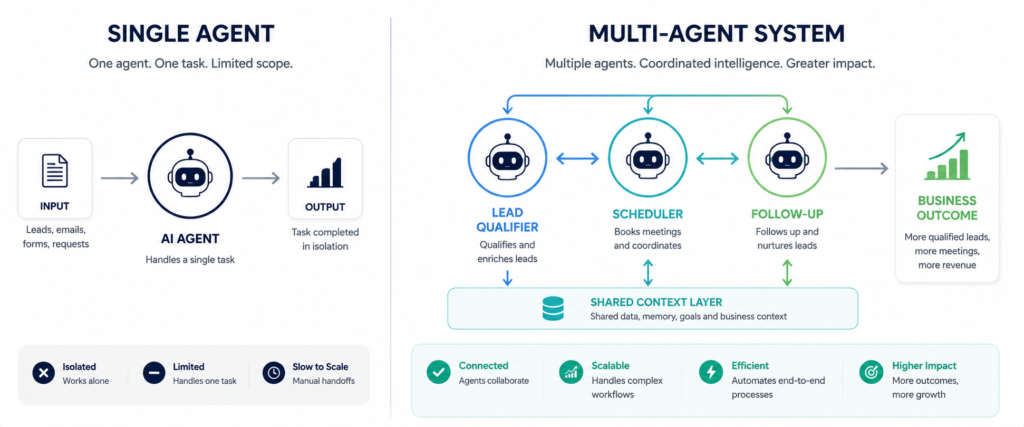
A single AI agent handles one specific task autonomously. A scheduling agent books appointments. A support agent answers customer queries. A lead qualifier agent scores inbound enquiries. Each operates independently and does not share context or coordinate with other agents.
A multi-agent system is where things get really interesting. It is about having multiple specialised agents working together like musicians in an orchestra, each playing their part but all coordinated to create something bigger.
In practical SME terms: where a single scheduling agent handles the booking step, a multi-agent system handles the entire customer journey from first enquiry through qualification, scheduling, confirmation, reminders, follow-up, and CRM update — with each specialised agent doing its part, and the combined system producing a result no single agent could achieve alone.
In 2026, 22 percent of production AI agent deployments already coordinate three or more agents. Adoption of the Model Context Protocol has crossed 9,400 public servers — the standard rails for cross-vendor agent ecosystems are now in place.
The key distinction that separates multi-agent AI systems from the automation tools most small businesses have used before:
Traditional automation handles pre-defined steps in sequence. If a condition changes or an unexpected input arrives, it breaks or routes to a human.
Single AI agents handle defined tasks autonomously and adapt to variation within that task, but do not coordinate with other systems.
Multi-agent systems handle connected workflows autonomously, with each agent specialising in its domain and passing context between agents so the overall workflow continues even when individual conditions vary. The system as a whole is more capable, more resilient, and more valuable than any individual agent within it.
The 4 Types of AI Agents That Deliver Real ROI for SMEs
Not every AI agent category is equally relevant to a small business with 10 to 250 employees. The following four types consistently deliver the fastest, most measurable ROI for SMEs based on production deployment data from 2025 and 2026.
Type 1 — Lead Qualifier Agent
What it does: Captures inbound enquiries from any channel — web form, email, WhatsApp, chat widget — applies your qualification criteria autonomously, scores each lead, and routes qualified prospects to your sales process or CRM, while rejecting or nurturing unqualified contacts automatically.
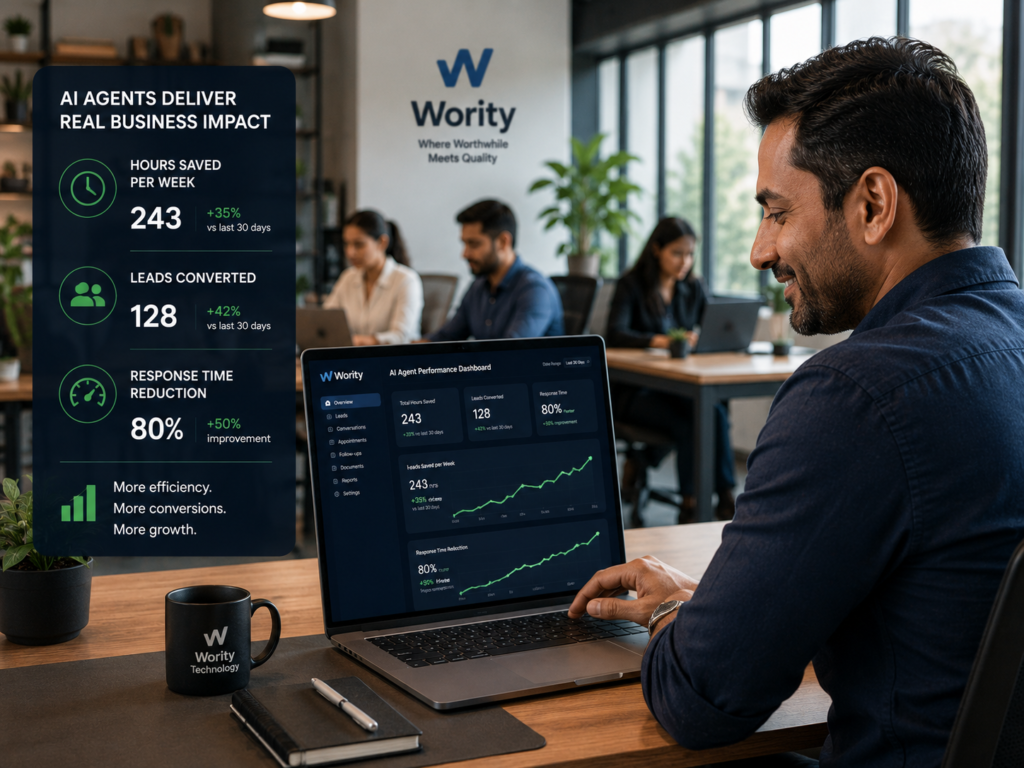
Why SMEs deploy it first: Most small businesses lose a significant proportion of their revenue potential to slow lead response. AI receptionists often pay for themselves in the first month from revenue recovered on missed calls. Speed to first response is the single most powerful predictor of whether a lead converts, and no human team can respond in seconds to every inbound enquiry at all hours.
The ROI data: AI lead qualifiers show an average 317 percent annual ROI with a 5.2-month payback period, according to SurFox’s 2026 analysis. McKinsey research on AI-enabled sales teams shows up to 15 percent conversion rate improvement — not because AI is better at selling, but because it qualifies faster and follows up within seconds rather than hours.
Running cost: $50 to $500 per month depending on volume and platform.
Type 2 — Scheduling and Appointment Agent
What it does: Handles the complete appointment lifecycle autonomously — receives booking requests, checks real-time calendar availability, books the appointment, sends confirmations, manages rescheduling requests, and delivers automated reminders to eliminate no-shows. Integrates directly with your calendar and CRM.
Why SMEs deploy it: Scheduling consumes 5 to 10 hours per week in most small businesses through back-and-forth communication, time zone confusion, and missed appointments because reminders were not sent. For consultants, agencies, clinics, and service businesses, this is often the fastest win — the lowest setup time with the quickest payback. Human cost comparison: $20,000 to $30,000 per year for a part-time admin. AI agent cost: $50 to $200 per month.
Running cost: $30 to $200 per month for most SME volumes.
Type 3 — Customer Support and FAQ Agent
What it does: Answers customer questions autonomously using your knowledge base, product documentation, and FAQ content. Handles Tier 1 queries — anything answerable from documented information — without human involvement. Routes complex, emotional, or high-stakes queries to a human with full conversation context attached.
Why SMEs deploy it: Chat and voice AI agents handle up to 80% of customer queries, slash resolution time, and improve customer satisfaction scores across deployments. For SMEs with high repetitive query volume — eCommerce, service businesses, clinics, agencies — this agent eliminates the support overhead that pulls the team away from higher-value work.
The critical deployment rule: Deploy AI for Tier 1 support first — anything answerable from your FAQ or knowledge base. Route everything else to a human. Do not try to automate the whole function on day one.
Running cost: $100 to $800 per month depending on volume and platform.
Type 4 — Follow-Up and Nurture Agent
What it does: Maintains automated personalised communication with prospects, existing customers, and inactive clients. Sends follow-up messages after meetings, trial periods, or purchases. Reactivates dormant contacts based on time or behaviour triggers. Updates CRM records based on engagement signals without human input.
Why SMEs deploy it: SDR agents have the lowest human-in-the-loop rate at 8 percent of any agent function — by design, since outbound prospecting is structurally narrow in scope. Median payback: 3.4 months — fastest of any function. Enterprises running SDR agents report 19% of net-new pipeline sourced through agentic outreach in Q1 2026.
Running cost: $80 to $500 per month depending on contact volume.
The Three-Agent Starter System Every SME Should Build First
The most common question from SME owners evaluating multi-agent AI for the first time is: which agents should I connect first, and in what order?
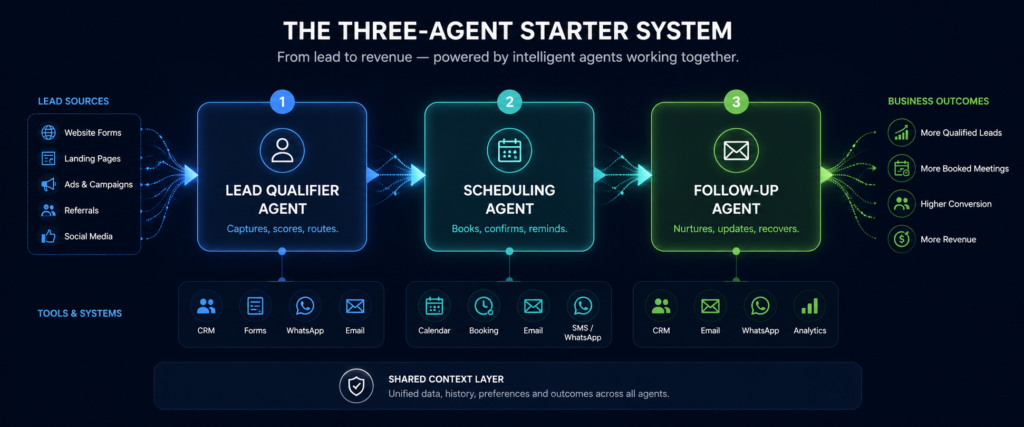
The answer from production deployment data is consistent. A three-agent system frees 10 to 15 hours per week within 30 days for a typical SME. The three agents that produce this result, connected in sequence:
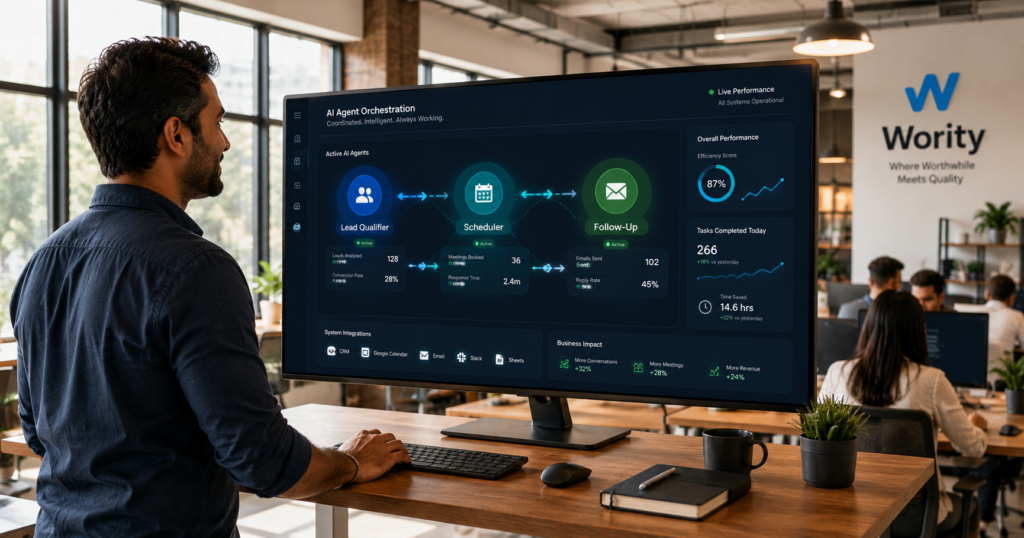
Agent 1 — Lead Qualifier: Captures every inbound enquiry from every channel. Applies your qualification questions and scoring criteria. Routes qualified leads to Agent 2. Notifies the sales team for high-value prospects. Sends nurture sequences to not-yet-qualified contacts automatically.
Agent 2 — Scheduler: Receives the qualified lead from Agent 1 with full context attached. Checks real-time calendar availability. Offers the prospect a booking link or completes the booking directly through the conversation. Sends confirmation and adds the appointment to your CRM. Sends reminder sequences before the appointment.
Agent 3 — Follow-Up: After the appointment or interaction, sends a personalised follow-up within the appropriate timeframe. Tracks response and engagement. Sends additional touches based on non-response. Updates the CRM with engagement status. Escalates re-engaged contacts back to the sales team with context.
The three agents pass context between themselves so the entire workflow from first contact to closed relationship operates without any manual data transfer. The business owner or sales team enters the process only at points that genuinely require their judgment — the complex sales conversation, the bespoke proposal, the relationship-building moment.
What the combined system replaces: a lead capture coordinator, a scheduling coordinator, and a follow-up coordinator — roles that consume 15 to 25 hours per week of expensive team time in a typical SME and are among the highest-volume, most repetitive workflows in any service business.
What Multi-Agent AI Systems Actually Cost for SMEs in 2026
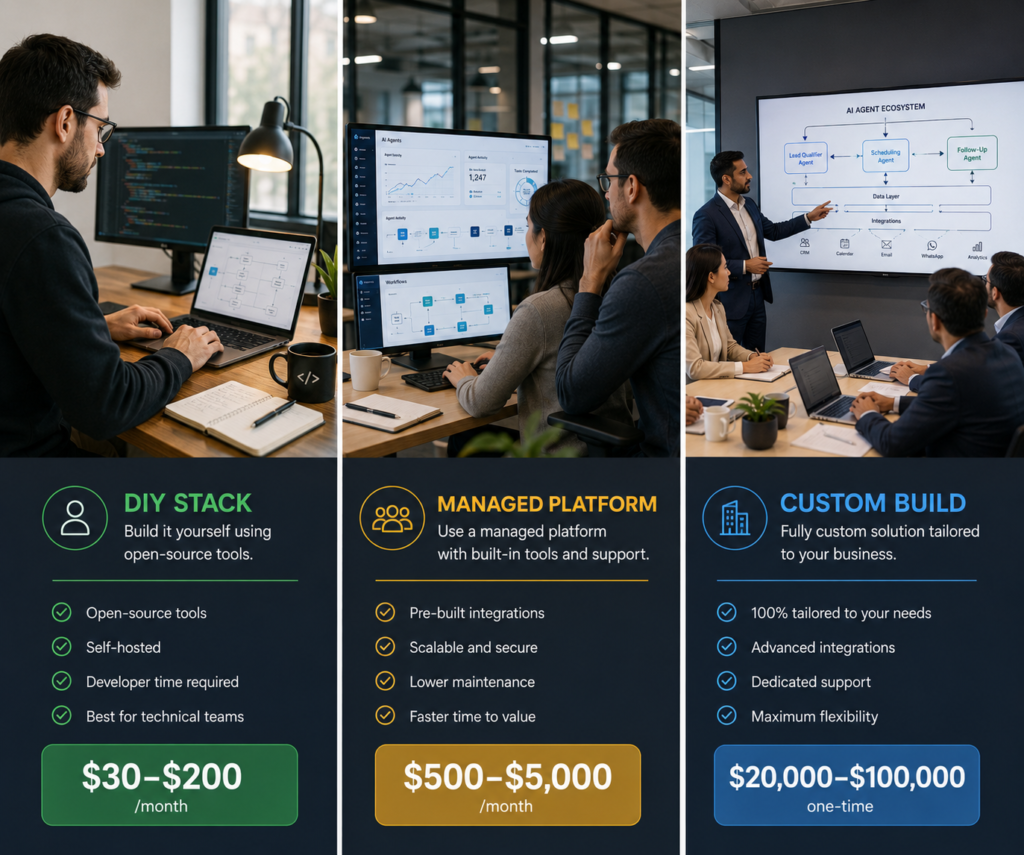
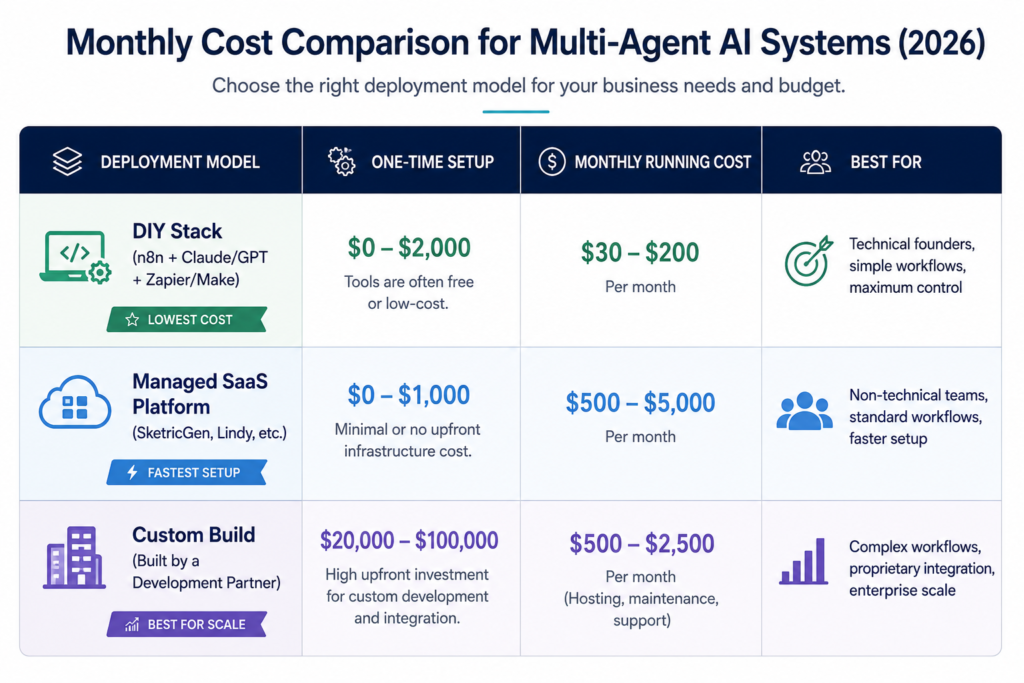
Cost transparency is the most valuable thing any AI technology guide can offer an SME making this decision. The range in the market is enormous — from $30 per month to $500,000 for a custom enterprise system — and almost nothing in between is described clearly enough for a non-technical business owner to understand what they are actually comparing.
For most SMEs, starting with a managed solution and migrating to custom once you have validated the use case is the most cost-efficient path. Off-the-shelf SaaS tools are almost always cheaper in the short term — you can be live in days for under $1,000 in setup costs.
Five costs SMEs consistently miss:
(1) API consumption — agents make 5 to 20 LLM calls per task, so a $300 platform fee can carry $400 of API cost
(2) Integration maintenance — each connected system needs auth and schema updates roughly quarterly
(3) Prompt drift — model upgrades break carefully-tuned prompts, requiring 2 to 4 hours rework per release
(4) Escalation handling — 5 to 15% of cases need human review
(5) Governance — audit logs, prompt versioning, and PII handling for regulated industries. Budget 1.5x the headline platform price for true total cost of ownership.
The DIY Stack — For Technical Founders and Lean Teams
The lowest-cost multi-agent system for an SME in 2026 uses open-source or low-cost automation orchestration combined with LLM APIs. The typical stack:
n8n (self-hosted: under $50 per month, or cloud plan) as the workflow orchestration layer connecting your agents, tools, and data sources. Claude Sonnet or GPT-4o Mini via API as the AI engine inside each agent — token costs for typical SME volumes are $20 to $150 per month. WhatsApp Business API through a BSP for customer-facing communication. Zoho CRM or HubSpot free tier for lead and contact management. Google Calendar or Calendly for scheduling integration.
Total monthly running cost for a three-agent lead-qualify-schedule-follow-up system: $30 to $200. Initial setup time: one focused afternoon for a technically comfortable founder, or $1,000 to $5,000 for a development partner to build it for you.
Managed SaaS Platforms — For Non-Technical Teams Who Need Speed
Managed platforms provide pre-built agent templates, visual workflow builders, and technical support — reducing deployment time from weeks to days for non-technical teams. The trade-off is higher monthly cost and less flexibility for complex or proprietary workflows.
For Year One, an SMB might invest $500 to $2,500 in subscription fees and basic API usage for a managed platform deployment. In Years Two and Three, these costs stabilise around subscription and usage fees, with incremental increases tied to business growth and expanded agent functionality.
The evaluation criteria for managed platforms: does it integrate natively with your existing tools (CRM, calendar, communication channels), does it support multi-agent orchestration or only single-agent workflows, and what is the vendor’s policy on data ownership and portability when you eventually need to migrate.
Custom Build — For Complex Workflows and Long-Term Scale
The cost of developing a custom autonomous AI agent can range widely from $20,000 for simple agents to $500,000-plus for complex enterprise systems, depending on workflow complexity, integration requirements, security specifications, and model training needs.
For most SMEs, a custom build makes commercial sense when three conditions are met: the workflow being automated is complex enough that standard platforms cannot handle it reliably, the volume of automation justifies the investment over a two-to-three-year horizon, and vendor lock-in from a managed platform creates unacceptable long-term risk.
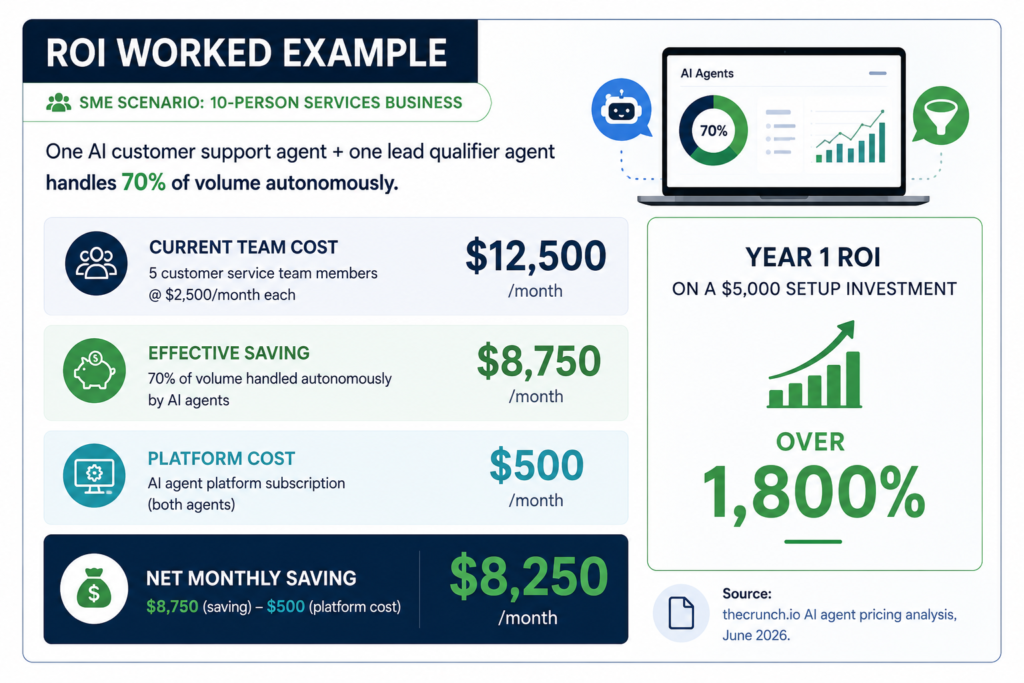
Well-implemented AI agents typically deliver 200 to 500 percent ROI in Year 1 through labour cost savings, faster response times, and revenue recovery from previously missed opportunities. At that ROI rate, even a $50,000 custom build investment has a payback period of under 12 months for most SME scopes.
Why July 2026 Specifically — The Three Conditions That Make This the Window
The timing claim in this blog’s title is specific and deliberate. Three conditions have converged in mid-2026 that did not exist simultaneously at any earlier point, and that will not remain as advantageous as this competitive window closes.
Condition 1 — The Infrastructure Just Matured
Adoption of the Model Context Protocol has crossed 9,400 public servers — the rails for cross-vendor agent ecosystems are forming. The Model Context Protocol (MCP) is the technical standard that allows AI agents from different vendors to communicate, share context, and hand off tasks to each other. Before MCP reached this adoption level, building multi-agent systems required either using a single vendor’s entire stack (creating lock-in) or custom integration work for every agent-to-agent connection.
With MCP widely adopted, an SME can connect a Claude-powered lead qualifier agent to an OpenAI-powered scheduling agent to a Zoho-native follow-up automation without custom integration code between each step. The interoperability infrastructure that was missing from the market in 2024 and early 2025 is now in place.
Condition 2 — The Costs Reached SME Accessibility
Single-agent systems held 59.24% market share in 2025, favoured for simplicity and lower cost. Multi-agent systems will close that gap rapidly. The specific cost that fell is model inference pricing. Running a complex multi-agent workflow in 2024 required either expensive enterprise API pricing or significant self-hosted infrastructure. In 2026, GPT-4o Mini, Claude Haiku, and Gemini Flash have reached price points where running 5 to 20 model calls per agent task — the typical volume for a three-agent workflow at SME scale — costs $20 to $150 per month in API fees.
The businesses that move first on this will have a meaningful operational advantage by the end of 2026. Not because agents are magic. Because they eliminate the manual overhead that quietly costs 10 to 20 hours per week in every growing business.
Condition 3 — The Competitive Window Is Still Open for SMEs
Agentic AI implementation remains largely in the experimentation stage, regardless of company size. The average point differential between experimentation and partial deployment across company sizes is 56%. In plain terms: most businesses, including most of your competitors, are still experimenting. They have not yet deployed agents in production.
By 2028, AI agent ecosystems will enable multi-application, multi-function collaboration, and one-third of user experiences will shift from native apps to agentic front ends. The businesses that are running multi-agent systems in production in Q3 2026 will have 18 to 24 months of production data, optimised workflows, and trained teams before those 2028 projections arrive. The competitive advantage compounds over time. The window for building it efficiently is now.
The Real ROI Numbers — Production Data from 2026 Deployments
These are not vendor marketing projections. These are documented outcomes from production deployments published by independent researchers and practitioners in 2025 and 2026.
Running four AI agents instead of four human hires saves $174,000 to $265,000 per year at US market rates. AI lead qualifiers show an average 317% annual ROI with a 5.2-month payback period. AI receptionists often pay for themselves in the first month from revenue recovered on missed calls.
Median payback on agent deployments overall: 5.1 months, with SDR and lead-qualifier agents paying back in 3.4 months — fastest of any function. Finance and operations agents take longer at 8.9 months due to higher human-in-the-loop requirements.
The typical result across SME deployments with 10 to 250 employees: 15 to 25 hours saved per week, per business, within the first 30 days. A three-agent system specifically frees 10 to 15 hours per week within 30 days at an operating cost of under $200 per month.
Enterprises that deploy AI agent systems estimate up to 50% efficiency gains in customer service, sales, and HR operations. Chat and voice agents handle up to 80% of queries, slash resolution time, and improve customer satisfaction scores.
Well-implemented AI agents typically deliver 200 to 500 percent ROI in Year 1 through labour cost savings, faster response times, and revenue recovery from previously missed opportunities.
What Multi-Agent AI Systems Cannot Do — The Honest Limits
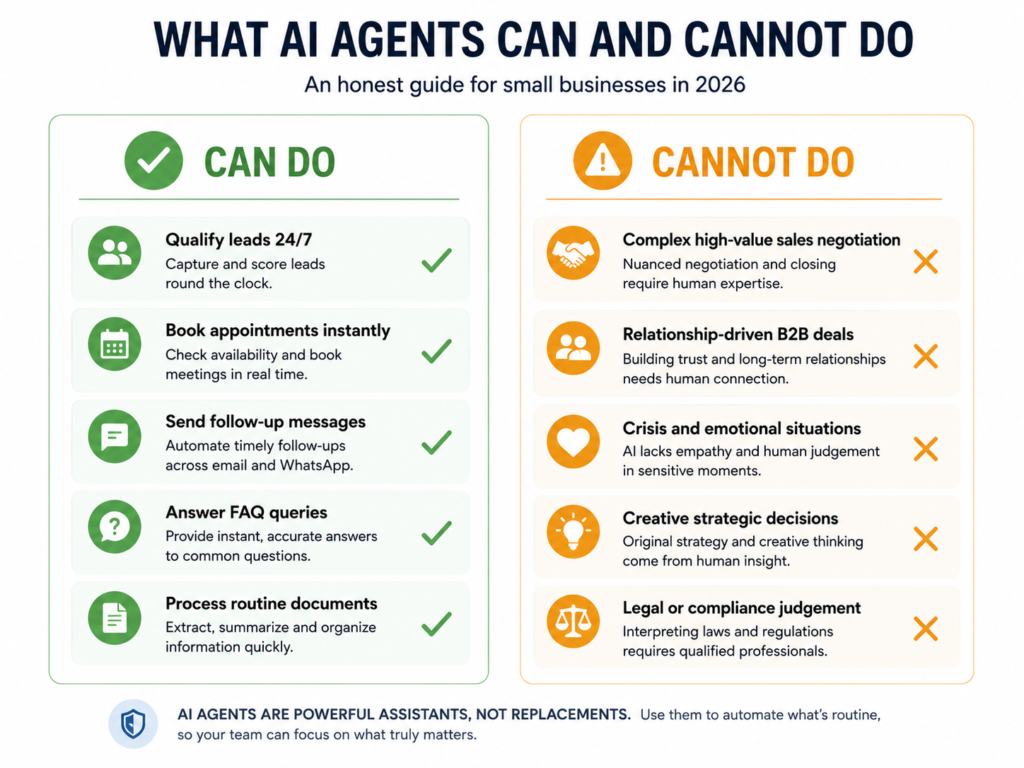
Any guide that describes only the capabilities without the limits is a vendor brochure, not a business decision tool. Here is the honest picture of where multi-agent AI systems stop delivering value for SMEs in 2026.
Complex B2B sales with high contract values and multi-stakeholder sales cycles still close better with human reps. Relationship management and navigating organisational politics remain genuinely difficult for current AI. Crisis and emotional situations — a customer whose order is three weeks late and threatening a chargeback needs a human on the line.
The current limits of multi-agent AI systems for SMEs, ranked by how often they cause deployment disappointment:
High-ACV, multi-stakeholder B2B sales: AI qualifiers excel at identifying interested prospects. They cannot replicate the relationship-building, negotiation, and trust-development required to close complex deals above $50,000 to $100,000 in contract value.
Novel situations with no precedent in training or documentation: agents make excellent decisions based on patterns from your historical data. When a genuinely unprecedented situation arrives with no comparable precedent, agents escalate or guess — and guessing in an autonomous workflow creates costly errors.
Legal, compliance, and regulated-industry judgement: any decision with legal consequences requires a human in the loop regardless of how well the agent performs on average. Design escalation paths for these situations before deployment, not after the first incident.
Creative strategic decisions: agents optimise within defined parameters. Redefining the parameters — changing your go-to-market strategy, pivoting your product positioning, deciding which market to enter — requires human strategic judgment that current AI cannot replicate.
Emotional intelligence in high-stakes customer situations: frustrated, upset, or distressed customers respond to human empathy. An agent that cannot detect emotional distress and escalate appropriately will damage customer relationships in the exact situations where human intervention matters most.
5-Step Deployment Plan: How to Build Your First Multi-Agent System
This is the deployment sequence that produces the most reliable results for SMEs building their first multi-agent AI system in 2026. Follow it in order.
Step 1 — Define the specific workflow before selecting any tool.
Write down the workflow you want the multi-agent system to handle: what is the trigger that starts the workflow, what does each agent need to do in sequence, what information passes between agents, where does a human enter the process, and what does the final output look like. If you cannot write this in one page of plain language, the workflow is not yet defined enough to build reliably.
Step 2 — Audit your data and tool connections.
List every tool the agents need to connect to — your CRM, your calendar, your email platform, your communication channel, your website form. Verify that APIs exist for each connection. Verify that your data in each tool is clean enough for an agent to act on it reliably. Poor data quality is the most common reason the first deployment underperforms expectations.
Step 3 — Build and test one agent at a time.
Start with Agent 1 — the lead qualifier or the intake agent — and test it independently before connecting Agent 2. Define acceptance criteria before testing: the agent must correctly handle 95 percent of test cases before being connected to the next agent. Add agents sequentially and test the handoff between each pair before moving to the next connection.
Step 4 — Define human escalation paths before go-live.
For every agent in the system, write down: what triggers escalation to a human, who the escalation goes to, what context the human needs to see when they receive the escalation, and what the expected response time is. Test every escalation path in the staging environment. Do not go live until escalations are confirmed working.
Step 5 — Monitor for two weeks before declaring success.
Build a simple monitoring dashboard — even a spreadsheet updated daily — tracking: total tasks processed, escalation rate, completion rate, error rate, and one outcome metric tied to your original business objective (leads converted, appointments booked, response time, hours recovered). Run it for two weeks before making any changes. Let the data tell you where to optimise.
Conclusion — The SME That Moves in July 2026 Is Building a Moat
The decision is no longer whether to deploy agents but which workflows justify the operating overhead.
By 2028, AI agent ecosystems will enable multi-application, multi-function collaboration, and one third of user experiences will shift from native apps to agentic front ends.
The small businesses running multi-agent AI systems in production by Q4 2026 will enter 2027 with 12 months of operational data on their specific customer base, workflows optimised through real-world iteration, and teams who know how to work with autonomous agents as part of their daily operations. The businesses that start in 2028 will start from day zero against competitors with that compounding advantage.
According to Grand View Research, the global AI agent market is projected to reach $182.97 billion by 2033, growing at an annual growth rate of 49.6% from 2026 to 2033. The SMEs that capture a share of that growth will not be the ones that waited for the technology to be perfect. The technology is already good enough to deliver 317 percent annual ROI on lead qualification, to free 15 hours per week per business, to save $174,000 to $265,000 annually compared to the equivalent human roles.
The infrastructure is mature. The costs are accessible. The competitive window is open. What comes next is a decision — not a technology one, but a strategic one.
Start with one workflow. Build three connected agents. Measure the result in 30 days. Then decide what to build next.
Frequently Asked Questions About Multi-Agent AI Systems for Small Business
Q: What is a multi-agent AI system for small business?
Q: How much does a multi-agent AI system cost for a small business in 2026?
Q: What is the ROI of a multi-agent AI system for an SME?
Q: What is the difference between a single AI agent and a multi-agent system?
Q: Why is July 2026 the right time for SMEs to deploy multi-agent AI?
Q: Which workflows should an SME automate with their first multi-agent system?
Ready to Build Your First Multi-Agent AI System?
Wority Technology builds production-grade multi-agent AI systems for SMEs globally — from workflow design and agent architecture to deployment, integration, and ongoing optimisation. We scope to your specific workflows, audit your data before we build, and deliver systems that work in production — not just in demos.
Book a Free AI Workflow Audit