
Every UK FinTech carries an invisible operational debt that grows every quarter: the compliance burden.
According to the SmartSearch Compliance Report 2026, UK businesses collectively spend £33.9bn annually on compliance activity — with 36% of that expenditure wasted on processes that could feasibly be automated. For a FinTech scaling through Series A or Series B, this is not an abstract market statistic. It is the compliance team working Fridays to complete KYC queues, the spreadsheet that tracks SMCR attestations, the regulatory report someone manually compiles from five different system exports every quarter, and the AML alert triage that consumes 60% of a compliance analyst’s week on genuine false positives.
The FCA regulates nearly 22,000 UK-registered businesses on anti-money laundering rules. Despite all rapid innovation, many FinTech firms continue to rely on manual processes for KYC, customer due diligence, monitoring, and reporting — practices that may seem cheaper on paper but often lead to bloated teams, slow onboarding, in-house inefficiencies, and high-risk exposure.
The cost of getting this wrong has never been higher. Global AML fines jumped 417% in the first half of 2025 to reach $1.23bn — driven by gaps in customer due diligence, sanctions screening failures, and inconsistent cross-jurisdictional processes. And that is before the reputational damage, the Section 166 review, and the senior management accountability that SMCR now makes personal.
The solution is not more compliance headcount. When asked how they would use time freed up by automation, 51% of compliance professionals said they would redirect it towards business development and client relationships.
Hyperautomation for UK FinTech compliance connects the three operational layers that currently create this problem — compliance workflows, customer relationship management, and regulatory reporting — into a single automated pipeline where data flows correctly between systems, audit trails are generated without manual effort, and compliance analysts spend their time on genuine risk decisions rather than data entry.
This guide covers the specific architecture, the FCA compliance requirements that govern it, the ROI data, and the deployment roadmap for UK FinTechs building this capability in 2026.
The UK FinTech Compliance Problem in 2026
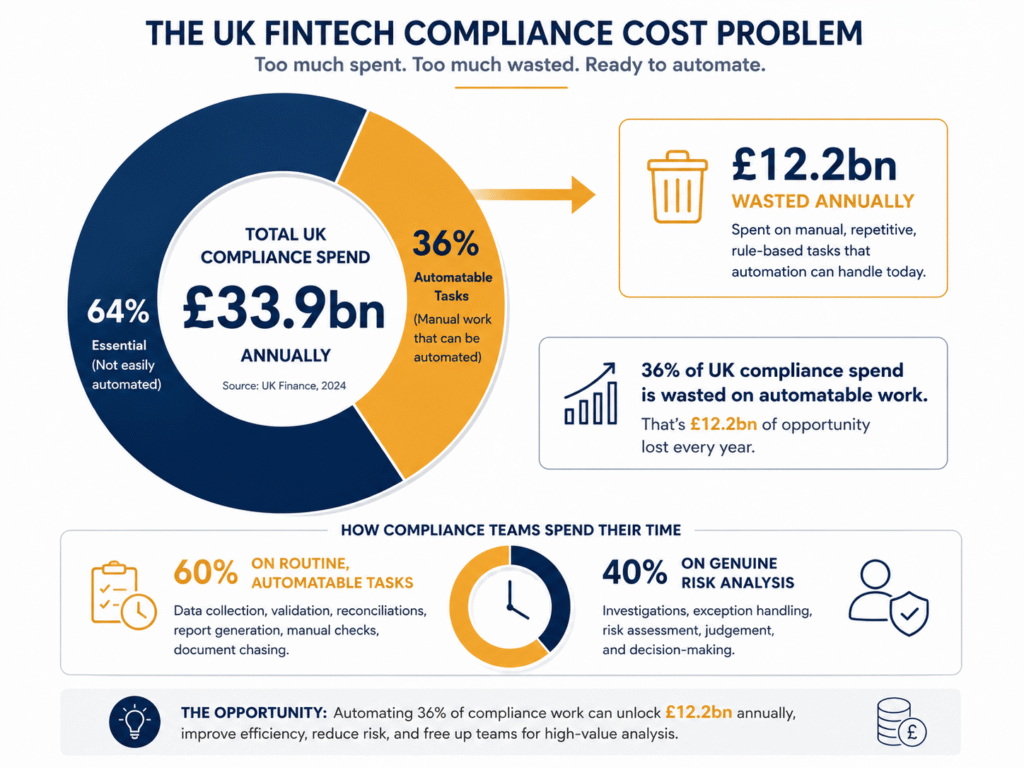
By 2026, regulatory compliance is among the top-3 biggest business challenges for UK organisations. Financial institutions, FinTechs, insurance companies, payment providers, and crypto-businesses must currently comply with a growing list of regulations. Total compliance costs for the UK financial services industry are between £33.9bn and £38.3bn each year, often exceeding 13% of a company’s operational expenses.
The specific regulatory landscape UK FinTechs navigate in 2026 has become significantly more demanding:
FCA Consumer Duty (PS22/9) came into full force in July 2024 and is now being actively enforced. It requires firms to empirically prove their actions resulted in good outcomes for consumers — not just that they followed a compliant process. The FCA has explicitly warned that algorithmic systems embedding or amplifying bias, or delivering opaque pricing, will be treated as direct breaches of the Consumer Duty.
SMCR personal accountability means that AI and automation failures have named individuals accountable. Under SM&CR, personal accountability for AI failures falls on the SMF24 (Chief Operations) and SMF4 (Chief Risk). The AML MLRO cannot use a black-box defence for missed transactions.
Money Laundering Regulations amendments are anticipated in late 2026. The Failure to Prevent Fraud offence introduces criminal liability for directors in early 2027. FCA supervision extends to legal and accounting firms by 2029. 72% of firms expect the complexity of the regulatory environment to increase over the next 12 months.
Manual compliance workflows often involve multiple systems, duplicated data entry, email approvals, spreadsheet tracking, and repeated document reviews. A customer onboarding journey that should take minutes can stretch into days due to internal handoffs and review queues. Analysts frequently spend significant portions of their day gathering information rather than making risk decisions. Over time, these inefficiencies become hidden operational costs that quietly erode margins and productivity.
Only 30% of firms currently use artificial intelligence for sanctions screening, even though it represents one of the highest-volume compliance tasks businesses perform. The gap between where most UK FinTechs are operating and where the tools allow them to operate is the hyperautomation opportunity.
The Connected Workflow Architecture — Compliance, CRM, and Reporting
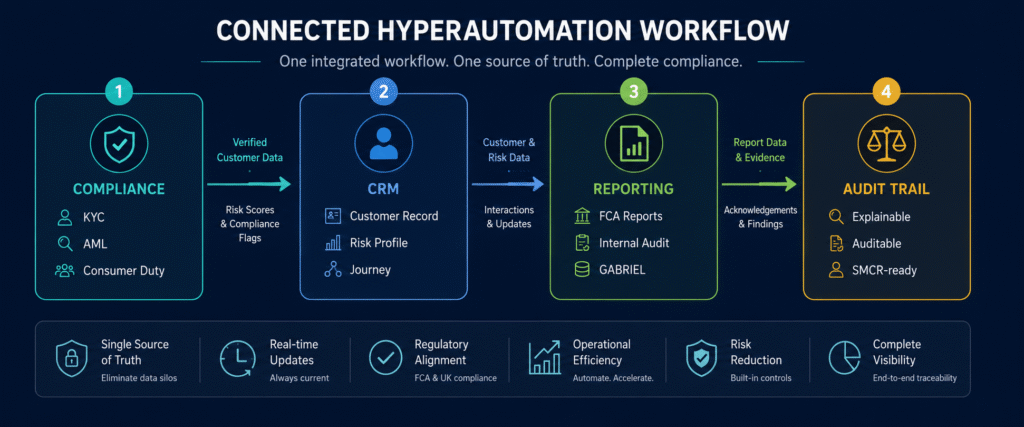
The hyperautomation architecture for a UK FinTech has three core layers and one essential output:
Layer 1 — Compliance automation: KYC, AML, Consumer Duty monitoring, SMCR attestation, sanctions and PEP screening.
Layer 2 — CRM integration: every compliance event automatically updates the customer record with verified identity status, risk score, compliance history, and next review date.
Layer 3 — Regulatory reporting: every compliance action populates the regulatory reporting log automatically, generating FCA-ready reports, internal audit trails, and GABRIEL submission data without manual compilation.
The essential output — an audit trail that is complete, consistent, explainable, and available for FCA review at any point — generated automatically by the workflow rather than assembled manually after the fact.
What makes this architecture different from having three separate systems is the data flow. What is created in a manual compliance environment is a disjointed compliance process, where decisions, documents, and risk indicators are kept in separate systems. This problem only gets worse as transaction volume grows. In a hyperautomated workflow, a new customer onboarding event triggers all three layers simultaneously. The KYC verification happens and its output flows directly into the CRM record and the compliance log. The compliance log feeds the reporting layer. The reporting layer generates the audit trail. No one transfers data manually between any of these systems.
Stage 1 — Compliance Automation: KYC, AML, Consumer Duty, and SMCR

KYC and Customer Onboarding Automation
A well-structured automated KYC process typically begins with secure capture of customer identity data — full legal name, date of birth, residential address, a government-issued ID, and a selfie for biometric matching — through a guided digital interface that validates submissions in real time.
For a UK FinTech, automated KYC delivers three simultaneous outcomes. First, onboarding speed: what currently takes 24 to 72 hours of manual document review compresses to minutes with automated identity verification, document validation, and database cross-referencing running in parallel. Second, consistency: every customer goes through the same documented process with the same checks applied in the same sequence — producing the consistent CDD documentation that FCA reviews consistently find lacking in manually operated firms. Third, conversion rate: customers who experience fast, frictionless digital onboarding are significantly more likely to complete it than those who encounter delays and document request loops.
The urgency is reinforced by worsening fraud statistics. A 2026 Alloy report found that over 22% of financial institutions lost more than $5m to fraud in 2025, with 86% expecting the problem to worsen. Global AML fines jumped 417% in the first half of 2025, driven by gaps in customer due diligence, sanctions screening failures, and inconsistent cross-jurisdictional processes.
The FCA compliance requirement here is documentation depth. The automated KYC system must produce a complete record of every check performed, every data source queried, every document reviewed, and the decision reached — with timestamps and the logic trail that produced each risk scoring decision. Automated systems solve the consistency problem inherently: they apply the same checks every time, every customer, with complete documentation.
AML Transaction Monitoring Automation
Traditional AML transaction monitoring applies fixed thresholds to every customer — flag any transaction above £10,000, flag any transaction to a specific country. The result is alert queues saturated with false positives that consume compliance analyst time without producing genuine risk intelligence.
Behavioural monitoring compares transactions against the account’s own normal transaction history instead of applying the same fixed threshold to every customer. The system raises an alert only when activity looks unusual for that specific account. Institutions using behavioural monitoring have reported alert volume reductions between 40 and 60%. That allows compliance teams to spend less time reviewing harmless alerts and more time investigating real risks.
AI and ML begin supporting risk detection, anomaly identification, case prioritisation, and predictive analytics all in one single system. The compliance process is driven by real-time tracking, self-learning, and autonomous decision-making engines that evolve in accordance with the risks and regulatory updates — with humans in the loop only for genuine decisions.
The SMCR and MLRO implications are critical. The AML MLRO cannot use a black-box defence for missed transactions. Any AI-powered AML system must produce explainable alert decisions — not just a flag, but a documented reasoning trail for why this transaction triggered a review. The automation handles the volume. The MLRO evidences appropriate oversight because the system produces the documentation that makes oversight possible.
Consumer Duty Monitoring and Reporting
FCA Consumer Duty (PS22/9) introduced the most significant shift in UK financial regulation in a generation. The key word in the requirement is empirically: firms must empirically prove their actions resulted in good outcomes.
The Consumer Duty flips the regulatory paradigm. Firms can no longer demonstrate they followed a compliant process; they must empirically prove their actions resulted in good outcomes for consumers. As the FCA moves from implementation to active enforcement, it has explicitly warned that algorithmic systems embedding or amplifying bias, or delivering opaque pricing, will be treated as direct breaches of the Consumer Duty.
Hyperautomation supports Consumer Duty compliance through continuous outcome monitoring: every customer interaction logged, every product recommendation tracked against outcome, every pricing decision documented with the logic that produced it. The compliance reporting layer aggregates this data automatically into Consumer Duty outcome reports that demonstrate the empirical evidence the FCA requires — without compliance teams manually assembling evidence from multiple systems.
The five mandatory documentation artefacts for defensible FCA compliance posture in 2026: bias audits, Consumer Duty impact assessments, model drift logs, incident response plans, and SMCR accountability documentation. A hyperautomated system generates or populates all five automatically from operational data.
SMCR Attestation Automation
The Senior Managers and Certification Regime requires documented accountability chains, regular attestations from certified individuals, and evidence that senior managers have appropriate oversight of the functions they are accountable for. Manual SMCR management — spreadsheets tracking certification status, email reminders for attestation deadlines, manual compilation of oversight evidence — is significant ongoing overhead for any UK FinTech with a compliance team of more than a handful of people.
Automated SMCR workflows manage the attestation calendar, send structured reminders to certified individuals at defined intervals, collect completed attestations through a documented digital process, and maintain the centrally accessible compliance record that evidences appropriate oversight. When the FCA requests evidence of SMCR compliance — which happens without notice — the automated system provides instant access to the complete, current attestation record rather than requiring someone to compile it under pressure.
Stage 2 — CRM Integration: How Compliance Data Becomes Customer Intelligence
Every compliance event in Layer 1 produces data that is commercially valuable as well as regulatorily required: the customer’s verified identity, their risk profile, their compliance status, and their interaction history. In a non-integrated system, this data lives in the compliance system and is unavailable to the CRM. In a hyperautomated workflow, it flows automatically to both.
When KYC verification completes for a new customer, the CRM record is updated automatically with verified status, the risk score assigned by the compliance system, the documents verified, and the compliance review date. When an AML alert is investigated and resolved, the CRM updates with the resolution outcome. When Consumer Duty monitoring identifies a customer interaction that requires follow-up, a CRM task is created automatically for the relevant relationship manager.
Relationship managers and product teams working in the CRM have real-time visibility of each customer’s compliance status without accessing the compliance system separately. Sales and customer success teams know immediately when a customer’s compliance review is due, enabling proactive outreach rather than reactive compliance chasing. Customer risk profiles available in the CRM inform product eligibility, credit decisions, and service level allocations without duplicate data entry.
For UK FinTechs where regulatory status directly affects the commercial relationship — neobanks, lenders, payment providers — the integration between compliance status and CRM creates a single customer view that serves both regulatory and commercial functions from the same data set.
Stage 3 — Regulatory Reporting Automation

Regulatory reporting is the most consistently underestimated operational overhead in UK FinTech compliance. FCA GABRIEL submissions, AML annual reports, Consumer Duty board reports, internal risk committee reporting, and senior management information packs all require data from multiple systems to be extracted, validated, structured, and presented on recurring schedules.
Traditional reporting tools rely on batch data extraction, scheduled aggregation jobs, and manual validation steps. The reporting pipeline typically has multiple stages where human review is required to catch errors introduced at earlier stages. Automating this pipeline with continuous data ingestion rather than batch extraction eliminates the data validation bottleneck and removes the manual steps.
In a hyperautomated compliance reporting workflow: every compliance event is logged in structured format as it occurs — not compiled retrospectively at reporting time. The reporting layer aggregates compliance event data continuously, calculating the metrics required for each report type automatically. At the required reporting interval — weekly, monthly, quarterly, or annually — the system generates a complete draft report populated from the continuous data feed, ready for compliance officer review and sign-off rather than manual compilation.
The specific outputs the reporting layer generates for a UK FinTech: FCA GABRIEL submissions structured in the format FCA systems require; Suspicious Activity Reports drafted automatically from AML case management outputs and queued for MLRO review; Consumer Duty board reports with outcome data automatically populated; SMCR attestation completion status reports; and internal audit trail documentation that is complete, timestamped, and searchable.
Instead of explaining how things should work, companies can show how things do work, backed by system logs, audit trails, and measurable activity. This kind of visibility builds confidence. It shortens due diligence timelines, strengthens bank-FinTech partnerships, and shows regulators that compliance is not an afterthought.
The FCA Compliance Guardrails — What Every UK FinTech Must Get Right
This section covers the non-negotiable compliance requirements that govern how hyperautomation is designed and deployed in a UK FCA-regulated FinTech. These requirements affect the architecture of the system, not just its outputs.
Consumer Duty (PS22/9) — Explainability Required
The FCA has explicitly warned that algorithmic systems embedding or amplifying bias, or delivering opaque pricing, will be treated as direct breaches of the Consumer Duty. LLMs are probabilistic text generators prone to hallucinations — if an AI chatbot inaccurately summarises exit fees, the firm is liable. Firms cannot rely on unsupervised generative AI for substantive financial communications. Every automated decision that affects a customer outcome must be explainable in terms a customer could understand and auditable in terms a regulator could verify.
SMCR Personal Accountability
Under SM&CR, personal accountability for AI failures falls on SMF24 (Chief Operations) and SMF4 (Chief Risk) — no new AI-specific function will be created. The MLRO cannot use a black-box defence for missed transactions. Senior managers must demonstrate genuine oversight of automated systems — including documented review of AI model performance, alert quality, and outcome data.
UK GDPR — Automated Decision Making
UK GDPR Article 22 requires that automated decisions significantly affecting individuals must have a documented legal basis, and individuals must be able to request human review. For KYC decisions, credit decisions, and risk categorisations made by automated systems, UK FinTechs must maintain documentation to respond to data subject access requests and demonstrate legal basis for processing.
AML and KYC Obligations
The FCA has emphasised deficiencies in customer due diligence process, documentation, governance, and controls in many firms. Automated KYC must be designed with the FCA’s CDD requirements as the specification, not as an afterthought.
The Five Mandatory Documentation Artefacts for 2026
Bias audits, Consumer Duty impact assessments, model drift logs, incident response plans, and SMCR accountability documentation form the minimum defensible compliance posture for any Section 166 review. Your hyperautomation system must generate or populate all five from operational data automatically.
The FCA’s Annual Work Programme for 2025/26 explicitly commits to accelerating digital innovation to improve productivity. By end of 2026, the FCA is expected to publish comprehensive, practical guidance on the application of existing consumer protection rules to AI use and accountability under SMCR for harm caused through AI. UK FinTechs deploying hyperautomation now are building systems against a regulatory framework that is moving toward greater clarity and support for compliant automation.
The ROI of Hyperautomation for UK FinTech Compliance
The return on hyperautomation investment for a UK FinTech compliance function flows through four distinct categories.
ROI Category 1 — Compliance Cost Reduction:
36% of UK compliance spend is wasted on automatable tasks. For a FinTech spending £500,000 annually on compliance operations, the addressable annual saving is £180,000. This is the most direct and most easily quantified ROI category — hours eliminated from KYC processing, AML alert triage, report compilation, and SMCR attestation administration.
ROI Category 2 — Onboarding Conversion Improvement:
Manual KYC processes that take days destroy conversion rates. Customers who encounter a 48-hour wait for document review frequently abandon the onboarding journey. For a FinTech onboarding 500 customers per month at 10% average abandonment during manual KYC delays, reducing KYC to real-time verification recovers 50 customers per month — at whatever your average customer lifetime value is.
ROI Category 3 — Regulatory Risk Cost Avoidance:
72% of firms expect regulatory complexity to increase. The Failure to Prevent Fraud offence introduces criminal director liability in early 2027. The cost of a regulatory breach — fine, remediation, Section 166 review, senior management time, reputational damage — is not calculable in advance. But the probability of a breach is directly correlated with the consistency and completeness of compliance documentation. Automated compliance workflows systematically reduce breach probability by eliminating the inconsistency and documentation gaps that FCA enforcement actions trace back to.
ROI Category 4 — Analyst Time Redeployment:
Institutions using behavioural AML monitoring report alert volume reductions of 40 to 60%. For a compliance team of five analysts each spending four hours per day on alert triage, a 50% reduction in alert volume frees ten analyst-hours per day — 2,600 hours per year. 51% of compliance professionals say they would redirect freed time to business development and client relationships. At a senior compliance analyst fully loaded cost of £65,000 per year, 2,600 hours represents £82,000 in recoverable capacity annually.
Deployment Roadmap — 4 Phases for UK FinTech Hyperautomation
The majority of UK FinTechs currently operate compliance processes at level 2 to level 3; major banking institutions and agile digital FinTechs are transitioning towards AI-enhanced compliance models. The following four-phase roadmap reflects how successful UK FinTechs are making this transition without disrupting live compliance operations.
Phase 1 — Compliance Workflow Audit (Weeks 1 to 3)
Document every manual step in your current compliance workflow: how long each KYC check takes, how many AML alerts your team reviews per day, how long report compilation takes per cycle, and who is responsible for each SMCR attestation. This baseline is both the starting point for ROI calculation and the specification from which your automation architecture is designed.
Identify the three highest-volume, most repetitive compliance tasks. These are your Phase 2 automation targets. In most UK FinTechs the ordering is: KYC verification steps first (highest volume, most consistent process, fastest payback), AML alert triage second (highest analyst time cost), and regulatory report compilation third (highest senior management overhead).
Phase 2 — KYC Automation First Deployment (Weeks 3 to 10)
Deploy automated KYC as the first workflow. Select a RegTech vendor with documented FCA compliance, a signed Data Processing Agreement for UK GDPR compliance, and integration capability with your existing CRM and case management system.
Key technical requirements for Phase 2: the KYC system must produce a complete, structured audit trail for every verification performed. The risk score must be explainable in documented terms — not a black-box output. The integration with your CRM must be bidirectional — compliance status flows to CRM, and CRM events (like a customer changing address) trigger compliance review workflows.
Run Phase 2 in parallel with your existing manual process for the first four weeks. Compare outcomes on a sample of customers processed through both. Document the accuracy of the automated system, the completeness of its audit trail, and the time saving achieved before decommissioning the manual process.
Phase 3 — AML Monitoring and Reporting Integration (Weeks 10 to 20)
Upgrade from fixed-threshold AML monitoring to behavioural analytics. The implementation connects the new AML system to your transaction data feed, establishes baseline behavioural profiles for each account type over a 60-day learning period, and shifts alert generation from fixed rules to anomaly detection relative to individual account behaviour.
Connect the AML case management system to the regulatory reporting layer. Every investigated alert, every SAR decision, and every AML case closure generates a structured compliance event that feeds the reporting log automatically. The MLRO receives a draft monthly AML report populated from case management data rather than compiled from multiple system exports.
Phase 4 — Consumer Duty Monitoring and Full Audit Trail (Months 5 to 8)
Deploy continuous Consumer Duty outcome monitoring — the capability that generates the empirical evidence the FCA now requires. This connects every customer interaction channel — your app, your customer service platform, your CRM — to a unified outcome tracking layer that records what happened at each interaction, what the customer experienced, and what the outcome was.
Phase 4 delivers the full audit trail capability that makes an FCA Section 166 review a scheduled administrative process rather than an operational crisis. Every compliance event from every workflow is searchable, timestamped, and structured — available for regulatory review at any moment, not compiled under pressure after a request arrives.
Conclusion — The Compliance Function That Funds Itself
For many FinTechs, the cost of manual compliance is not the payroll. It is the potential business opportunity lost. The primary risk of using manual compliance procedures is not the cost of doing business; it is the risk of being non-compliant. As customer volume, transaction volume, and regulation increase, it becomes increasingly challenging to maintain consistent control over the process.
As FCA Chief Executive Nikhil Rathi has put it: the speed and complexity of modern markets require systems capable of keeping pace with autonomous, high-speed activity, making manual oversight increasingly inadequate.
Hyperautomation for UK FinTech compliance is not a technology project. It is an operational transformation that replaces manual processes incapable of keeping pace with the regulatory environment with automated systems specifically designed to meet FCA requirements. The three layers — compliance automation, CRM integration, and regulatory reporting — are not separate investments. They are a connected architecture that eliminates the data silos, documentation inconsistencies, and manual overhead that characterise most current UK FinTech compliance operations.
36% of the £33.9bn spent annually on UK compliance could be automated. For an individual FinTech, the addressable saving represents a compliance function that pays for its own transformation.
The regulatory window for building this capability is defined. With FCA supervision extending to legal and accounting firms by 2029, Money Laundering Regulations amendments anticipated in late 2026, and the Failure to Prevent Fraud offence introducing criminal director liability in early 2027, the window for complacency is rapidly closing.
UK FinTechs that build hyperautomated compliance infrastructure in 2026 will meet 2027’s regulatory requirements with the operational capability already in place.
Frequently Asked Questions About Hyperautomation for UK FinTech Compliance
What is hyperautomation in UK FinTech?
How much does UK FinTech spend on compliance and how much is wasted?
Does hyperautomation comply with FCA Consumer Duty requirements?
What is the ROI of compliance automation for UK FinTech companies?
What compliance workflows can be automated for UK FinTechs in 2026?
What FCA compliance requirements must UK FinTechs address when automating?
Ready to Connect Your FCA Compliance, CRM, and Reporting?
Wority Technology builds custom hyperautomation systems for UK FinTechs — connecting FCA compliance workflows, CRM, and regulatory reporting in a single integrated pipeline. We understand the FCA regulatory framework, Consumer Duty requirements, SMCR accountability structures, and the specific integration challenges of UK financial services technology stacks. Built for compliance from day one, not retrofitted for it.
Book a Free FinTech Compliance AuditSee Our AI Automation Services