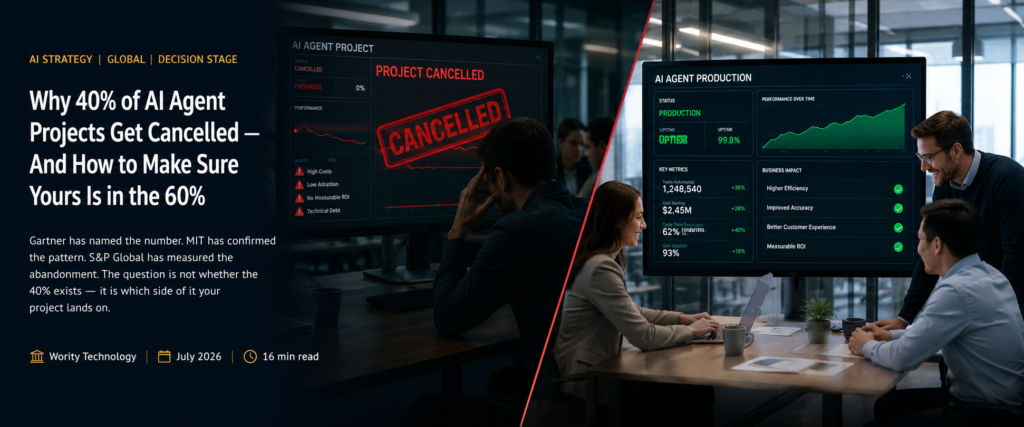
Why 40% of AI Agent Projects Get Cancelled — And How to Make Sure Yours Is in the 60%
The pilot demos beautifully.
The AI agent drafts the reply, reconciles the invoice, books the meeting before anyone asks. Everyone in the room nods. The vendor shows the slide with the ROI projection. The budget gets approved. And then the project goes into production — against whatever Tuesday throws at it — and it stalls on the unglamorous stuff.
The invoice has a missing field. The customer record is duplicated. The agent hits an API limit it was never told about. The compliance team finds out the agent has been accessing data it was not cleared to see. The CFO asks at the quarterly review what the project returned, and the room goes quiet.
That silence is what a cancellation sounds like.
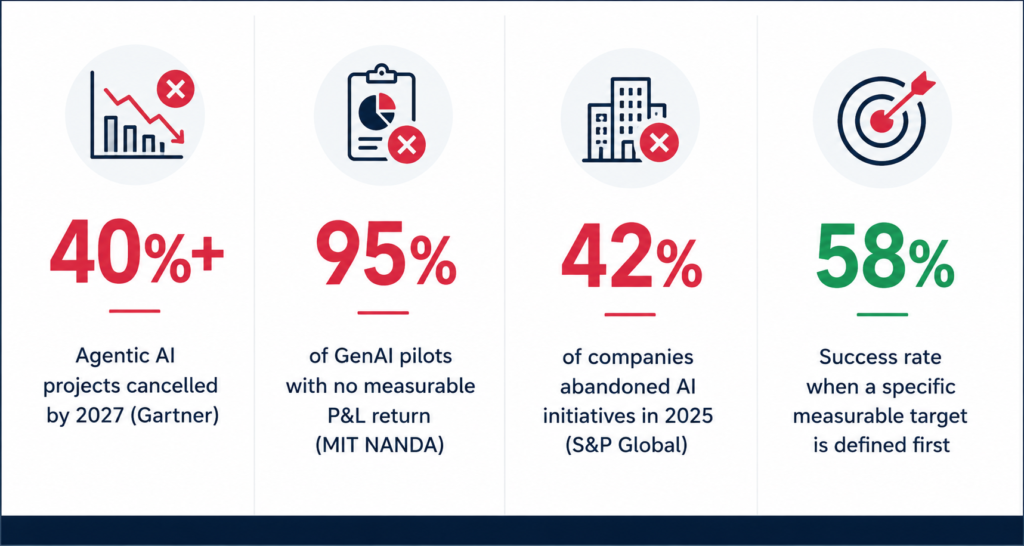
Gartner predicts 40-plus percent of agentic AI projects will be cancelled by 2027. Meanwhile, 79% of organisations are already deploying them. That gap between deployment speed and success rate is the defining paradox of enterprise AI in 2026. The technology works. The projects still fail.
S&P Global Market Intelligence found that 42% of companies abandoned most of their AI initiatives in 2025, up sharply from 17% a year earlier. MIT Project NANDA found that 95% of generative AI pilots show no measurable profit-and-loss return. RAND Corporation reports more than 80% of AI projects fail to deliver their intended business value — roughly twice the failure rate of comparable IT projects without AI.
The failure is not a technology problem. The failure mode that kills most agentic AI projects is not the AI technology itself. It is the assumption that deploying an autonomous agent is a software deployment problem, when it is actually an organisational change management problem that happens to involve software.
This blog covers the seven most common AI agent project failure reasons in 2026 — sourced from the most credible research available, not from vendor marketing — and the specific steps that put your project in the surviving 60%. If you are at the decision stage, mid-pilot, or in the uncomfortable middle ground where the demo was great but production feels further away than expected, this is the guide that will tell you what to do next.
The Anatomy of an AI Agent Project Failure
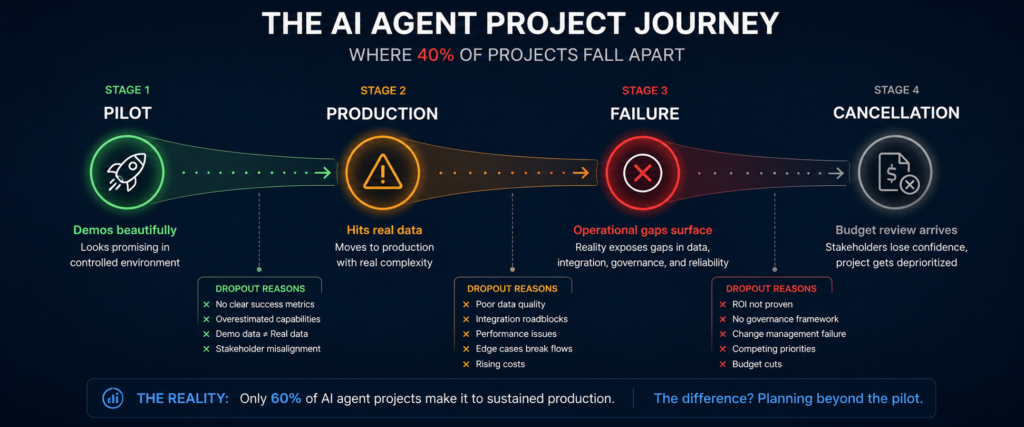
Before the seven failure reasons, it helps to understand the shape of a typical AI agent failure — because they rarely look like a sudden crash. They look like a slow, expensive drift.
The pattern is consistent across industries, company sizes, and geographies. <cite index=”5-1″>The pilot-to-production gap is not primarily a technology problem. The models are capable. The tooling has improved dramatically. The gap is organisational and operational. Most enterprises lack the evaluation infrastructure, monitoring tooling, and dedicated ownership structures needed to move a promising pilot into reliable production.
In 2024, the Autonomous Agent dream was: give it a goal, and it figures it out. The reality in production is that figuring it out is just another word for unpredictability. You ask an agent to process an invoice, and it gets stuck in an infinite loop checking the same email 50 times, burning $400 in tokens before you can hit Stop.
The vendor market is starting to admit as much. Governed agents, guardrails, audit trails, and control towers are moving from afterthoughts to sales pitches, because early deployments have shown what breaks.
What breaks — in order of how frequently it happens — is documented in the seven failure reasons below.
Failure Reason 1 — No Defined Outcome Before the Technology Is Selected

This is the failure reason that appears in every credible study of AI project failure and is almost entirely invisible in the conversations that happen before a project starts. Organisations that define a specific, measurable problem — we want to reduce claim processing time by 40% — succeed at a 58% rate. Organisations with vague goals — we want to leverage AI for our business — fail the overwhelming majority of the time.
The specificity is not a nice-to-have. It is the architectural foundation on which every other project decision depends. If you cannot state your AI agent project outcome in a single sentence that includes a specific metric, a specific workflow, and a specific timeframe, you do not yet have a project. You have an intention.
Successful AI resource allocation follows a specific pattern: 10% algorithms, 20% technology and data infrastructure, 70% people and processes. Organisations that invert this ratio — investing primarily in algorithms and technology while neglecting people and process change — consistently fail. Yet the technology-first mentality persists because AI tools are tangible, purchasable, and demonstrable, while organisational change is difficult and unglamorous.
The budget review arrives six or twelve months later. The question asked is: what did this project return? MIT’s zero-return finding traces directly to organisations that skipped lag metrics. When budget reviews arrive, they have nothing to present.
The fix is not complicated. Before any technology evaluation begins, document three things: the specific workflow the AI agent will operate on, the baseline metric you are trying to move and its current value, and the target value and the timeframe in which you expect to reach it. If any of these three cannot be articulated, the project is not ready to start.
Failure Reason 2 — The Data Was Never Ready
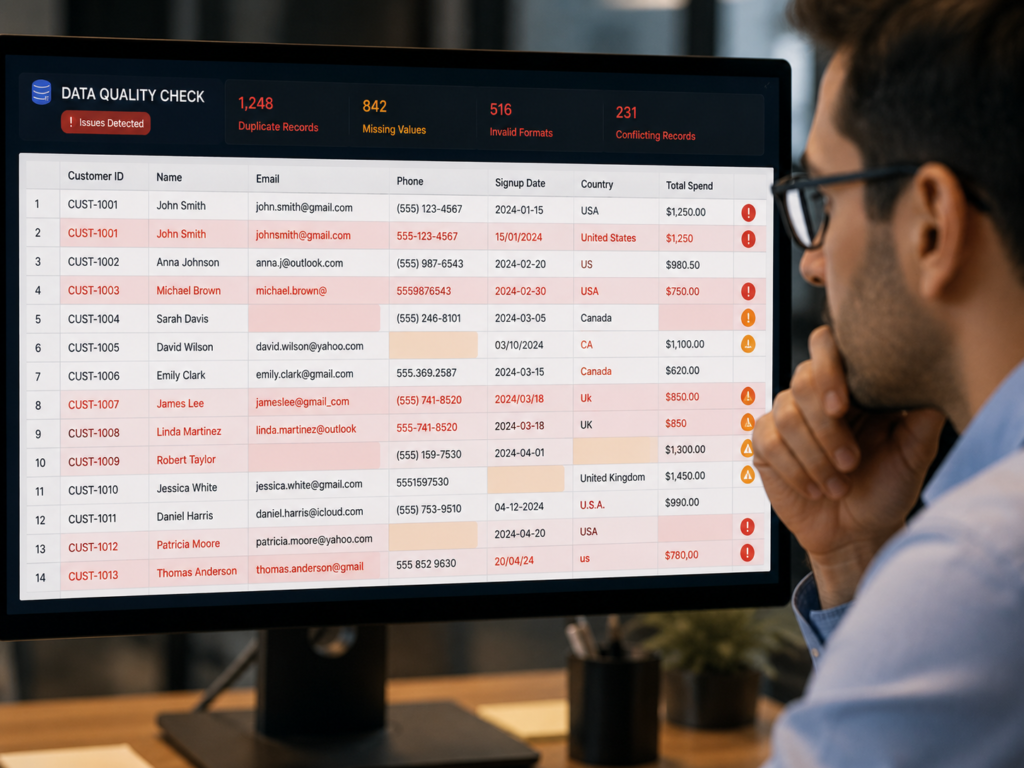
Insufficient AI-ready data — Gartner puts this at 60% of AI projects abandoned for this reason alone. The agent is built, the integration is connected, and it performs beautifully in the testing environment. Then it goes into production and immediately produces wrong outputs, because the live data it is operating on has the same quality problems that the test environment did not.
The specific data problems that consistently destroy AI agent deployments in production: duplicate customer records that cause the agent to create multiple conflicting lead entries, missing mandatory fields that stop automated workflows mid-execution, inconsistent formatting across data sources that the agent cannot reconcile, and historical records with errors that train the AI’s understanding of what normal looks like in ways that are inaccurate.
A major retail giant tried to build a Personalised Shopping Agent. The Crisis: you cannot build a $10M AI penthouse on a foundation of wet sand. The agent’s recommendations were based on purchase history data that had not been properly cleaned — and the results were not just wrong, they were visibly wrong in front of customers.
Through 2026, Gartner predicts that 60% of AI projects unsupported by AI-ready data will be abandoned. That rate is already at 42% of US companies.
The fix is a data readiness audit before a single line of agent code is written. Audit every data source the agent will interact with: are records complete, deduplicated, consistently formatted, and accurately reflective of current business reality? Document every gap with a named owner and a remediation timeline. This work is unglamorous, time-consuming, and essential. Projects that skip it are planning their own cancellation.
Failure Reason 3 — Integration With Legacy Systems Was Underestimated

Most organisations underestimate what it takes to move AI agents from pilot to production. Integration with legacy systems creates compatibility issues and data silos. The AI agent performs in the controlled test environment because the test environment was designed around the agent’s requirements. The production environment was designed around business requirements from five or fifteen years ago, and it was not designed with AI agents in mind.
Most enterprise environments are not greenfield deployments. An AI agent in the enterprise environment of 2026 hits fragmented data, missing permissions, and inconsistent APIs in production that simply did not exist in the sandbox.
The specific integration failure modes that appear most frequently: authentication and permissions that work in testing but fail against live system access controls, APIs that return data in formats different from what the test environment used, rate limits on external APIs that were never reached in low-volume testing but are hit immediately under production load, and orchestration failures when multiple systems that worked independently do not behave consistently when chained together in an agent workflow.
One agent is simple. Ten agents working in parallel on a single process is a complex system with its own race conditions, deadlocks, and failure modes. You need an orchestration layer that defines step ordering and dependencies, handles errors and retry logic, logs every action for audit purposes, and knows when to hand off to human oversight.
The fix is integration architecture design before build, not after. Map every system the agent must interact with. Document the specific API version, the authentication method, the rate limits, and the data format for each integration point. Test integrations in a staging environment that is as close to production as possible. Never assume that what works in testing will work in production without explicit validation.
Failure Reason 4 — No Human Oversight Framework

This is the failure mode that does not look like a failure at first. The agent is running. It is processing tasks autonomously. Everything appears to be working. And then it does something wrong at scale — makes an incorrect decision that propagates across hundreds of records, accesses data it was not authorised to see, or takes an action that violates a compliance requirement — and the incident that results is expensive in ways that go far beyond the project budget.
Agents are crossing from suggestion into action faster than most companies are building the controls to govern that action. That is the point where a sloppy deployment stops being a wasted pilot and starts being a liability.
Air Canada’s chatbot famously invented its own bereavement policy, promising a customer a refund that did not exist. A tribunal ruled the airline was legally responsible for the hallucinated policy. In 2026, The AI said so is not a legal defence.
Unsecured AI agents can access sensitive customer data, make decisions on behalf of employees, and take actions across your entire tech stack with little oversight. Without strong identity and access controls, you are one misconfigured permission away from a data leak or compliance failure.
The biggest mistake: deploying a fully autonomous agent without clearly defined points where a human enters the process. In customer support, this might be refunds above a certain amount. In HR, it might be any decision affecting payroll. In DevOps, it might be deployment to production. These rules must be designed upfront — not improvised after the first incident.
The fix is a governance framework designed before the agent touches production data. Define the specific actions the agent can take autonomously, the specific actions that require a human approval gate, the escalation path when the agent encounters a situation outside its defined parameters, the audit trail format for every action the agent takes, and the incident response process for when something goes wrong. Enterprises that invest early in bounded autonomy deploy agents into higher-value workflows sooner and more safely. The constraint becomes a competitive advantage.
Failure Reason 5 — Cost Escalation Nobody Budgeted For
The ones that started from the technology instead of the workflow discovered their cost problem after launch instead of budgeting for it. The pattern underneath is always the same: consumption-based pricing means cost scales with agent activity, agent loops multiply model calls per task, and most teams discover this after launch instead of budgeting for it.
This failure mode is unique to AI agent projects because the cost structure of agentic systems is fundamentally different from traditional software. A traditional application has a predictable infrastructure cost. An AI agent has a consumption-based cost that scales with every decision the agent makes — and agentic workflows make many more model calls per task than a simple chatbot interaction.
Agents that poll for updates — asking the agent Is the order ready? How about now? — waste 95% of their tokens. This Polling Tax kills agent projects not because the agent fails to work, but because it works at a cost the business cannot sustain at production scale.
The fix has two components. First, instrument your agent during testing to count the actual number of model calls per task completion. Multiply by your token pricing. Multiply by your expected production volume. Add 40% buffer. If this number is not in your project budget, the project will face a cost escalation crisis in production. Second, design your agent architecture specifically to minimise unnecessary model calls: use event-driven patterns and webhooks rather than polling loops, cache results where possible, and scope agent tasks to the minimum necessary actions for each completion.
Gartner sized the disruption at up to $234 billion of enterprise application spend exposed to agentic arbitrage by 2030. The winners and the casualties are buying the same models and the same GPUs. What separates them is boring: a real workflow, an eval suite, cost metering, human gates, and compliance scoped early.
Failure Reason 6 — Agent Washing: Buying a Chatbot and Calling It an Agent
Gartner estimated that of the thousands of companies claiming agentic capabilities, only about 130 were building anything that deserved the label. Much of the rest looked more like chatbots, robotic process automation, and assistants in new packaging. The industry even has a name for it now: agent washing.
Agent washing is the practice of rebranding existing automation tools — chatbots, RPA scripts, rule-based decision engines — as AI agents without the autonomous multi-step reasoning and adaptive decision-making capability that genuine agency requires. For buyers, this creates a specific and expensive problem: the tool that was sold as an AI agent that will autonomously manage your customer support workflow is actually a sophisticated chatbot that responds to pre-defined inputs and escalates everything else. It does not learn from outcomes. It does not adapt when it encounters unexpected conditions. It does not initiate actions. It responds to them.
Before blaming the technology, consider who is selling it to you. The bar for what constitutes an agent is not being enforced by the market. You must enforce it yourself.
The evaluation criteria for genuine agentic capability that every buyer should apply: the system must be able to initiate actions without a human prompt; it must handle multi-step workflows autonomously including branching logic when conditions change; it must adapt in real time when it encounters conditions not present in the training or testing environment; and it must integrate with live data sources and act on the results, not just read and report them.
Ask every vendor the same two questions: show me a live production deployment — not a demo environment — where this agent is autonomously completing multi-step workflows. And show me the logs of what the agent did when it encountered an unexpected condition in production. The answers to these questions will tell you more than any sales deck.
Failure Reason 7 — The Pilot-to-Production Infrastructure Gap
Most AI projects die in what researchers call Innovation Theatre. Prototypes work in sandboxes but lack the standardised protocols to integrate with live enterprise software stacks. Teams celebrate the demo without building the infrastructure required for sustained operation.
This failure mode is the one that catches organisations that have done many things right: they defined a clear outcome, they audited their data, they selected a genuine AI agent, they designed governance. And then they moved the working pilot to production without the operational infrastructure that production requires — the observability tooling that surfaces failures before users report them, the monitoring dashboards that show agent performance across the full task portfolio, the standardised deployment pipelines that allow updates without downtime, the runbooks that let operations teams maintain the system without the original developer present.
Production-ready AI agent architectures provide observability through OpenTelemetry, security through identity management, and reliability through checkpointing and state persistence. These are not optional features to add later. They are prerequisites for moving beyond the pilot phase. Organisations using systematic evaluation frameworks achieve nearly six times higher production success rates according to the survey.
The skills that differentiate teams that get to production from those that do not are not model selection or prompt optimisation. Those are table stakes. The differentiating skills are: evaluation design — building systematic tests that detect performance degradation before users do; observability implementation — instrumenting agents with structured logging that captures each reasoning step, tool call, and decision; integration architecture — designing agents that work with legacy systems rather than requiring greenfield environments; and operational handoff — creating runbooks and escalation procedures that the operations team can follow without the original development team present.
The 60% Framework: What Surviving Projects Do Differently

The research does not just document failure. It consistently identifies the same characteristics in the minority of AI agent projects that reach production and deliver measurable value. Here is the framework, synthesised from Gartner, MIT NANDA, RAND, Forrester, and independent practitioner research published in 2025 and 2026.
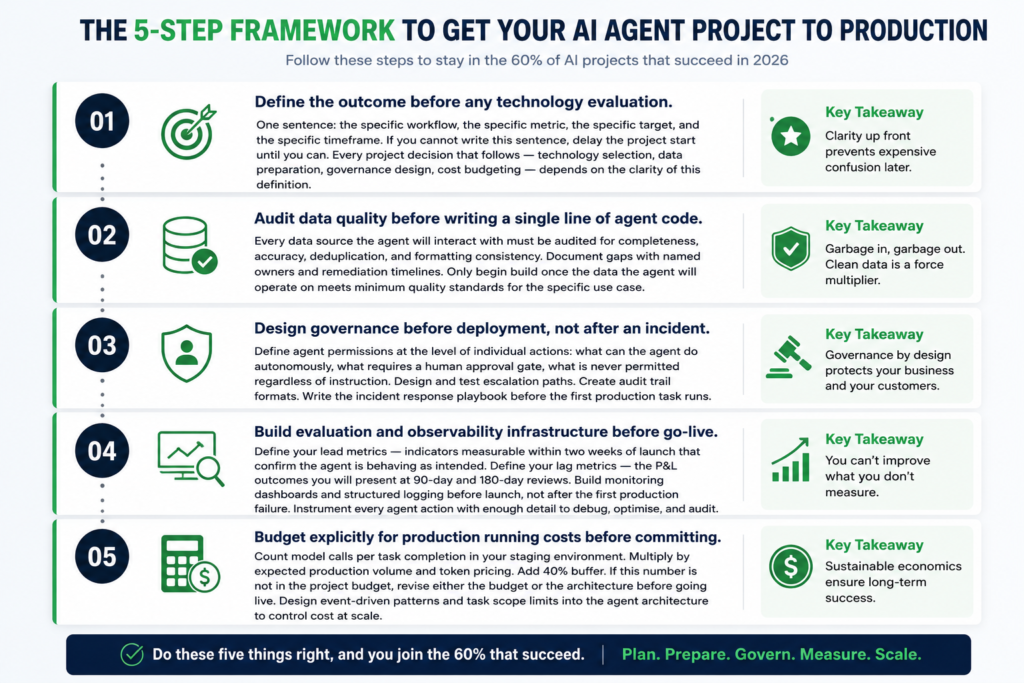
The Comparison: Projects That Fail vs Projects That Survive
| Factor | Projects That Get Cancelled (40%) | Projects That Reach Production (60%) |
|---|---|---|
Outcome definition |
Vague: “leverage AI” or “improve efficiency” |
Specific: measurable metric, workflow, timeframe |
Data readiness |
Assumed adequate, never audited |
Audited before build, gaps documented |
Governance |
Designed after first incident |
Designed before first production task |
Integration |
Tested in sandbox only |
Tested in staging matching production |
Cost budgeting |
Based on demo volume |
Based on measured production model calls |
Vendor evaluation |
Accepted “agentic” claims at face value |
Demanded live production deployment evidence |
Observability |
Added after something broke |
Built before go-live |
Ownership |
Unclear who manages in production |
Named owner with runbook and escalation path |
Definition of success |
None agreed in advance |
Documented lead and lag metrics defined at project start |
Pilot approach |
Broad scope, multiple workflows simultaneously |
Single workflow, single team, proved before expansion |
A Practical Note on Timing: Why July 2026 Is the Right Moment
The 40% cancellation rate is a verdict on execution, not on the market. By 2028, Gartner predicts 15% of day-to-day work decisions will be made autonomously by agentic AI — up from 0% in 2024. A third of enterprise software will include agentic capabilities — up from under 1% today. The winners and the casualties are buying the same models and the same GPUs.
The organisations entering AI agent projects now, in mid-2026, have a specific advantage: two years of documented failure cases from earlier deployments. The failure patterns are well-documented, the governance frameworks are maturing, the vendor landscape is being filtered by the market, and the evaluation criteria for genuine agentic capability are becoming clearer. The organisations that apply this accumulated knowledge to their 2026 deployments are not starting from scratch. They are starting from the lessons of the 40%.
The organisations that wait until 2028 to start will find themselves competing against businesses that will have two years of production data, two years of agent learning cycles, and two years of workflow optimisation that compounds the initial advantage. The argument for acting in 2026 is not urgency for its own sake. It is that the window for building meaningful early-mover advantage from a documented knowledge base is open right now — and it will not stay open indefinitely.
Conclusion — The 40% Is Not Inevitable. It Is Predictable.
The 40% of projects failing are the ones that chased the magic. The 60% that are succeeding are the ones that treated AI like legacy software engineering: with unit tests, state machines, and brutal data audits.
The research is unambiguous about what the 40% and the 60% look like before the project starts. The difference is almost entirely visible in the preparation: the clarity of the outcome definition, the honesty of the data audit, the discipline of the governance design, and the rigour of the cost modelling.
None of this is technically difficult. All of it is operationally demanding. And most of it is exactly what gets skipped when a project is sold on the demo, budgeted in excitement, and built under pressure to show results before the infrastructure exists to sustain them.
The 40% cancellation rate is predictable. Which means it is preventable. Start with a specific outcome. Audit your data honestly. Design governance before go-live. Build observability before the first production task runs. Budget for actual production costs. Demand evidence of live production deployment from every vendor you evaluate.
That is not a guarantee. But it is what the data says the 60% did.
Frequently Asked Questions About AI Agent Project Failure
What percentage of AI agent projects fail in 2026?
What are the most common reasons AI agent projects get cancelled?
What separates successful AI agent projects from failed ones?
What is agent washing and why does it matter?
How long does it take to move an AI agent from pilot to production?
How much does an AI agent project cost to run in production?