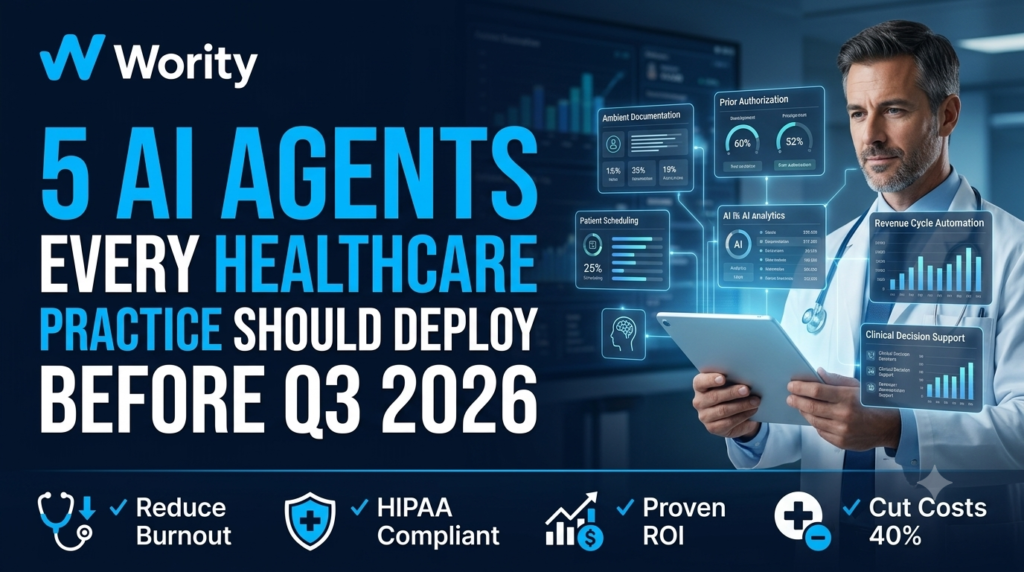
5 AI Agents Every US Healthcare Practice Should Deploy Before Q3 2026
The US healthcare system is spending more on administration than on care — and AI agents are finally doing something about it.
According to Deloitte’s 2026 US Health Care Outlook Survey, over 80 percent of US healthcare executives expect agentic AI to deliver moderate-to-significant value across clinical, business, and back-office functions this year. Sixty-one percent of organisations are already building and implementing agentic AI initiatives or have secured budgets for them. The question for most practices is no longer whether to invest. It is which agents to deploy first, and how fast.
AI agents in healthcare are fundamentally different from the chatbots and workflow tools of previous years. They are autonomous systems that perceive data, make decisions, take actions, and learn from outcomes — without requiring a human to direct each step. They are being deployed in US healthcare settings right now to automate clinical documentation, process prior authorizations, manage appointment scheduling, coordinate care workflows, and drive revenue cycle efficiency. The results being reported are not incremental. They are transformative.
One appointment scheduling AI deployment reported 468 percent ROI. One prior authorization platform reports 8x ROI with 94 percent provider satisfaction. A claims appeals process that previously took 15 to 16 days has been reduced to 1 to 2 days using an AI agent. Ambient clinical documentation AI is reducing physician burnout scores by 31 percent in peer-reviewed clinical trials. These are not forecasts. They are production deployments happening in US practices today.
This guide identifies the five AI agents delivering the highest verified ROI for US healthcare practices in 2026, explains what each one does in plain language, shows the real numbers behind each deployment, and tells you exactly what to evaluate before choosing a vendor. If your practice is serious about operational efficiency, revenue recovery, and clinician retention in 2026, these are your first five moves.
Why Q3 2026 Is the Deadline That Matters

The phrase “Q3 2026” is not an arbitrary urgency device. It reflects the specific competitive dynamics of the US healthcare market in the second half of this year.
Becker’s Hospital Review confirmed in early 2026 that this year marks the definitive shift from pilot programs to enterprise-scale AI deployment across US healthcare. The practices that deployed ambient documentation AI in 2024 and 2025 are now one to two years into production data — their AI systems are more accurate on their specific patient populations, their workflows are optimised, and their clinicians are trained. The practices beginning deployment today are starting from day zero against competitors running optimised, learning systems.
The supply-side is also constraining timelines. EHR integration certification for Epic App Orchard takes 8 to 16 weeks per vendor certification. Implementation of AI agent platforms with full EHR connectivity typically requires 4 to 16 additional weeks depending on complexity. A practice that begins its vendor evaluation process in Q3 2026 should plan for production deployment in Q4 2026 at earliest — which means the operational benefit flows into 2027. Practices evaluating now and committing in the next 8 to 12 weeks have a realistic path to Q3 production deployment.
There is also a financial deadline. Medicare’s Quality Payment Program and value-based care contracts increasingly incorporate operational efficiency and patient experience metrics that AI-enabled practices are better positioned to optimise. Practices that build AI capability into their operations in 2026 will be better positioned to perform under these programs throughout 2027 and beyond.
The 5 AI Agents — Ranked by Production ROI in US Healthcare Deployments
The following agents are ranked based on documented production deployments in the US healthcare market in 2025 and 2026. The ranking reflects a combination of clinical outcome impact, operational ROI per encounter or per clinician, scale of the addressable population, and time to positive payback — consistent with Taction Software’s May 2026 independent analysis of the top 12 AI healthcare use cases by ROI.
Agent 1 — Ambient Clinical Documentation AI

What It Does
An ambient clinical documentation AI agent listens passively to the clinician-patient conversation, transcribes the dialogue in real time, and generates a structured clinical note — SOAP notes, H&P notes, progress notes — directly into your EHR via FHIR integration. The clinician reviews and signs. No dictation. No typing during the visit. No after-hours documentation catch-up.
This is not voice-to-text software. Traditional speech recognition requires the clinician to narrate into a microphone in structured format, catching their own errors in real time. Ambient AI understands the natural flow of a patient conversation, identifies what is clinically relevant, organises it into the correct documentation structure, and applies the appropriate ICD-10 and E/M coding guidance — automatically.
The Evidence
The evidence base for ambient AI documentation is now exceptionally strong. A University of Wisconsin randomised clinical trial published in NEJM AI demonstrated that ambient AI reduced burnout scores by a clinically meaningful margin and cut documentation time by 30 minutes per clinician per day. A multicenter JAMA Network Open study found a 31 percent drop in reported burnout and a 30 percent boost in physician well-being among ambient AI users. The Cleveland Clinic deployed ambient AI documentation to 4,000-plus clinicians, saving 14 minutes per provider per day. A UCLA study across 72,000 patient encounters using Nabla found documentation time reduced by nearly 10 percent at scale.
Documentation time reductions of 20 to 75 percent are now well-documented across published health system case studies, with 30 to 60 percent being the most consistently reported range according to Taction Software’s May 2026 systematic review.
The ROI Mathematics
At an average US physician fully-loaded compensation of $250 per hour, 60 to 90 minutes recovered per day per clinician equals $25,000 to $37,500 per clinician per year in capacity recovered. For a 10-physician practice, this is $250,000 to $375,000 annually. For a 30-physician group, it is $750,000 to $1.1 million. Against a typical ambient documentation platform cost of a few hundred dollars per clinician per month, the payback period is measured in weeks.
The secondary ROI driver is revenue capture. Ambient AI with integrated point-of-care coding consistently improves ICD-10 and HCC coding accuracy, capturing revenue that was previously lost to under-coding. Ambience Healthcare, which integrates directly with Epic, Cerner, and athenahealth, specifically targets this as a measurable outcome alongside burnout reduction.
Leading Vendors to Evaluate
DAX Copilot by Microsoft / Nuance — the market leader, deployed across hundreds of health systems, Epic-native integration. Abridge — strong clinical accuracy, used extensively in academic medical centres, Abridge now embedded in Epic natively. Ambience Healthcare — multispecialty coverage with point-of-care coding. Note: athenahealth launched its own native ambient documentation tool, athenaAmbient, in February 2026 at no additional cost to all athenahealth EHR users — verify availability for your specific modules.
Deploy by Q3 Checklist — Agent 1
Before selecting an ambient documentation vendor, verify:
The vendor has a signed BAA and HIPAA-compliant data handling with encryption of all PHI in transit and at rest.
The integration is certified with your specific EHR — not just “compatible with Epic” but specifically certified for your Epic modules and version.
You have a defined clinician onboarding plan — adoption requires 2 to 4 weeks of training before productivity gains are measurable.
Agent 2 — Prior Authorization AI Agent

What It Does
Prior authorization is one of the most time-consuming administrative burdens in US healthcare — and one of the most automatable. A prior authorization AI agent determines whether a requested procedure, medication, or referral requires prior authorization, initiates the request with the appropriate payer, monitors status, follows up automatically, and escalates to a human reviewer only when genuinely necessary. For denied claims, a denial management AI agent reads the denial letter, assembles corrected or supplementary documentation, and routes it for nurse or physician approval — reducing a 15 to 16 day manual process to 1 to 2 days.
The AMA reported in 2023 that US physicians complete an average of 45 prior authorization requests per week, spending 14 hours weekly on this process — time equivalent to seeing 12 additional patients. In a specialty practice where every prior auth represents a high-value procedure, the bottleneck cost is enormous.
The Evidence
Cohere Health’s agentic prior authorization platform is the most documented deployment in the US market. Their platform processes prior authorizations in minutes compared to days for manual reviews, reports up to 8x ROI across deployments, and has achieved 94 percent provider satisfaction in published customer data. One health system reduced their prior authorization completion time by over 90 percent using AI automation. A major US insurer deploying agentic prior auth reported handling 40,000 prior authorization decisions per day with AI completing the majority autonomously. AI benefits verification agents now verify patient eligibility with 99 percent accuracy and a 10-second average verification time, at a 30 percent reduction in benefit verification costs, according to Prosper AI’s 2026 healthcare AI analysis.
The ROI Mathematics
The AMA calculates that the average physician spends 14 hours per week on prior authorization. At $250 per hour, that is $3,500 per physician per week — $182,000 per physician per year in time cost. Even a 70 percent reduction in prior auth time for a 5-physician practice recovers $637,000 annually. For the denied claims component: the average denied claim costs $25.20 to rework manually, with prior auth-related delays creating an additional $54,000 per full-time equivalent in administrative overhead according to revenue cycle benchmarks.
Leading Vendors to Evaluate
Cohere Health — market-leading dedicated prior auth AI with strong payer relationships. Infinitus AI — voice AI handling prior auth phone calls with payers autonomously. Olive AI — end-to-end prior auth workflow integration. Waystar — revenue cycle platform with integrated prior auth automation.
Deploy by Q3 Checklist — Agent 2
Before selecting a prior authorization AI vendor, verify:
The vendor has active integrations with the specific payers covering your patient population — not generic payer connectivity.
Prior auth automation includes denial management capability — authorisation approval alone captures only half the available ROI.
The vendor provides performance SLAs on prior auth turnaround time — hold them contractually to the performance benchmarks in their case studies.
Agent 3 — AI Patient Scheduling and Communication Agent
What It Does
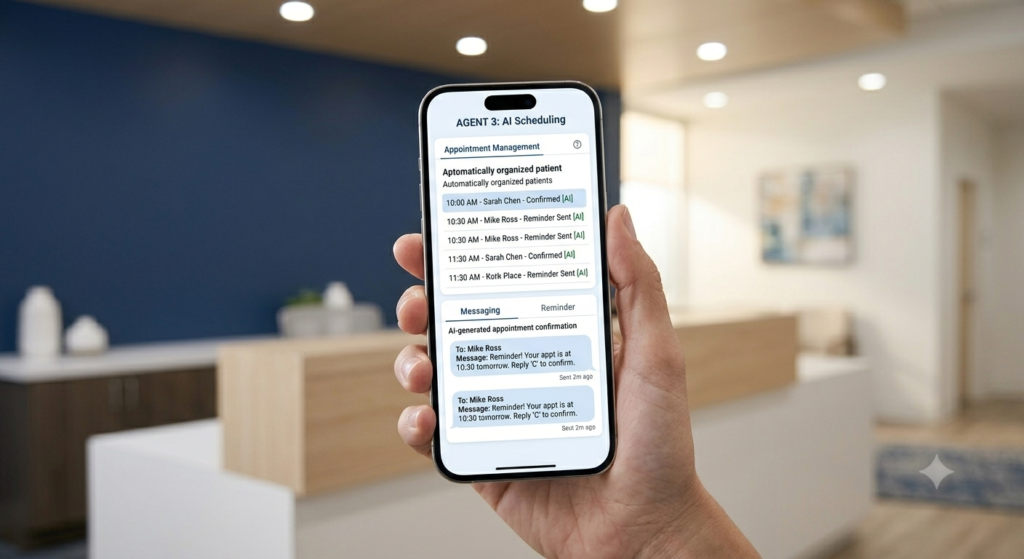
An AI patient scheduling and communication agent handles the complete appointment lifecycle autonomously — receiving appointment requests through any channel (web, phone, SMS, patient portal), checking real-time provider availability, applying insurance eligibility and visit type logic, booking the appointment in the EHR, sending confirmation through the patient’s preferred channel, and delivering automated reminders and pre-visit instructions. For the patient, the experience is instant, available 24 hours a day, and personalised. For the practice, it eliminates the phone-tag, the hold times, the scheduling backlogs, and the no-shows that consume front-desk capacity.
A California-based healthcare provider deployed AI scheduling agents to handle high call volumes across multilingual patient populations and extended clinic hours. The deployment delivered measurable reductions in no-show rates, improved staff satisfaction by eliminating repetitive phone tasks, and freed care coordinators for complex patient needs that genuinely required human judgment.
The Evidence
No-show rates drop 20 to 50 percent with AI scheduling and automated reminders, according to industry reporting cited in SOAP Note AI’s 2026 analysis. Scheduling response rates improve 10 to 20 percent. A Hartford HealthCare AI scheduling deployment is cited as a benchmark case for AI-driven appointment management. LitsLink’s May 2026 analysis documented one healthcare provider achieving 468 percent ROI and $3.2 million in revenue from appointment scheduling AI — primarily from converting previously lost scheduling opportunities and recovering revenue from reduced no-shows.
The commercial logic is direct. A no-show in a primary care practice costs $200 to $300 in lost revenue. A specialty practice no-show averages $500 to $1,500 in lost procedure or consultation revenue. For a practice with 200 appointments per week and a 15 percent no-show rate, reducing no-shows by 35 percent recovers $270,000 to $2.7 million annually, depending on specialty and patient mix
Leading Vendors to Evaluate
Memora Health — AI care coordination and scheduling platform with strong clinical pathway integration. Luma Health — patient scheduling automation with multilingual support and no-show prediction. Mend — telehealth and scheduling AI with documented no-show reduction outcomes. Klara — patient communication platform with AI scheduling capabilities for specialty practices.
Deploy by Q3 Checklist — Agent 3
Before selecting a patient scheduling AI vendor, verify:
The system reads and writes directly to your EHR schedule — not a separate scheduling database that creates sync conflicts with your clinical system.
Multilingual patient communication is available — essential for practices in metropolitan US markets with diverse patient populations.
The vendor provides no-show prediction capability, not just reminders — predictive recall of high-risk appointments is where the highest ROI is generated.
Agent 4 — Revenue Cycle Management AI Agent

What It Does
Revenue cycle management (RCM) AI agents work across the complete billing and collections workflow — automating medical coding, claims submission, denial management, payment posting, and patient collections communication. Medical coding AI agents apply the appropriate CPT and ICD-10 codes based on clinical documentation, improving accuracy and reducing the under-coding that leaks revenue from most practices. Claims management agents monitor claim status, identify likely denials before submission, and route high-risk claims for human review before they are rejected. For denied claims, AI agents draft appeal letters, assemble supporting documentation, and track the appeal through resolution.
The Evidence
Practices deploying AI coding copilots see an average 3 to 8 percent revenue increase from improved code capture accuracy, according to TechAhead’s 2026 analysis. AI-assisted coding has reached the point where it outperforms human coders on standardised accuracy benchmarks in documented studies. The administrative cost of billing — typically 15 to 25 percent of gross revenue for US practices — is the largest single overhead target for RCM AI. TechAhead’s 2026 analysis documents 25 to 50 percent administrative cost reduction and 58 percent faster patient support processing from comprehensive RCM AI deployment. Claims processing time reductions of 40 to 60 percent are consistently reported in production deployments.
The ROI Mathematics
For a practice billing $3 million annually, a 3 percent improvement in code capture accuracy generates $90,000 in recovered revenue. A 25 percent reduction in RCM administrative costs — assuming a typical 20 percent administrative overhead — saves $150,000 per year. The combined revenue recovery and cost reduction for a $3 million practice deploying AI RCM tools is approximately $240,000 annually. Implementation costs for RCM AI platforms range from $2,000 to $8,000 per month depending on scope, placing the payback period at 1 to 3 months for most practices.
Leading Vendors to Evaluate
Waystar — integrated RCM platform with AI coding, denial management, and claims automation. Availity — AI-powered claims management and prior auth with strong payer connectivity. Ambience Healthcare — point-of-care coding integrated with ambient documentation. Cohere Health — prior auth and denial management with AI-driven appeals processing.
Deploy by Q3 Checklist — Agent 4
Before selecting an RCM AI vendor, verify:
The vendor offers a revenue impact guarantee — reputable RCM AI vendors provide contractual performance commitments because the ROI is measurable and they can back it up.
Coding accuracy is validated on your specific specialty mix — coding AI trained primarily on primary care documentation performs differently on surgical subspecialty or behavioural health notes.
Denial management includes appeal drafting, not just denial categorisation — categorising denials without acting on them is where most under-performing RCM tools stop.
Agent 5 — Clinical Decision Support AI Agent

What It Does
Traditional clinical decision support (CDS) tools interrupt clinicians with alerts — many of which are dismissed as irrelevant. A 2025 analysis found that US physicians dismiss more than 90 percent of CDS alerts without acting on them, a phenomenon known as alert fatigue. Agentic CDS goes fundamentally further: it continuously monitors patient data streams across the EHR, correlates findings against clinical literature and institutional protocols, identifies high-risk patterns before they manifest clinically, and surfaces recommendations proactively — at the right moment in the clinical workflow, not as an intrusion on every order.
AI clinical decision support agents in 2026 monitor for sepsis early warning (with documented mortality reduction in deployed systems), readmission risk prediction (enabling proactive discharge planning and follow-up scheduling), drug interaction identification across complex polypharmacy cases, and chronic disease management gaps in preventive care workflows.
The Evidence
Sepsis early-warning AI agents represent the highest-acuity clinical decision support deployment with the most rigorous evidence base. Epic’s Deterioration Index, deployed in hundreds of health systems, has documented mortality reduction in ICU settings. Readmission risk prediction AI has shown 20 to 30 percent reductions in 30-day readmission rates in documented deployments — critical in a payment environment where CMS penalises hospitals for excess readmissions. KPMG’s 2026 healthcare AI survey found that 84 percent of respondents feel comfortable with AI making end-to-end autonomous decisions for specific clinical processes — a striking finding that reflects the maturation of clinician trust in AI-assisted decision support.
For ambulatory and outpatient practices specifically, AI-assisted chronic disease management has documented improvements in preventive care gap closure rates — reducing the proportion of diabetic patients without recent HbA1c checks, cardiovascular patients without LDL monitoring, and cancer screening-eligible patients without recent orders.
Leading Vendors to Evaluate
Epic CDS Hooks — native Epic clinical decision support framework supporting third-party AI integration through standardised hooks. Nuance DAX (extended) — moving beyond documentation into proactive clinical guidance in the 2026 roadmap. Health Catalyst — population health and decision support AI for health system and ACO settings. Aidoc — AI triage for radiology and emergency department settings, one of the most mature imaging AI deployments.
Deploy by Q3 Checklist — Agent 5
Before selecting a clinical decision support AI vendor, verify:
The system’s recommendations are explainable — the clinician must be able to understand why the AI is surfacing a specific recommendation, not just receive an alert.
Alert suppression and personalisation are configurable — a CDS system that cannot be tuned to your specific patient population and clinical context will reproduce the alert fatigue problem it is intended to solve.
Regulatory status is confirmed — clinical decision support AI that crosses the FDA Software as a Medical Device (SaMD) threshold requires appropriate regulatory review. Understand where your intended use sits on the FDA’s clinical decision support guidance spectrum before deploying.
The 5-Agent Comparison: At a Glance
AI Agent |
Primary Benefit |
Avg Time to ROI |
Key Metric |
Top Vendor Examples |
|---|---|---|---|---|
HIPAA Compliance: The Non-Negotiable Foundation for Every AI Agent
Every AI agent in this guide processes Protected Health Information (PHI). That means HIPAA compliance is not a vendor feature. It is a legal prerequisite that your practice is ultimately responsible for verifying before any deployment.
Before signing any AI vendor contract, confirm all five of the following:
A signed Business Associate Agreement (BAA) is available as a standard contractual document. Any vendor who treats the BAA as optional or delayed is not ready for healthcare deployment.
Data encryption covers PHI both in transit and at rest using AES-256 encryption at minimum. Ask for the vendor’s SOC 2 Type II report as evidence of their security controls.
Comprehensive audit trails log every patient data interaction — what data was accessed, what action the AI took, and when. This is required for HIPAA compliance and essential for your own quality oversight of AI outputs.
Data residency is confirmed as within the United States. PHI processed outside US borders creates additional regulatory complexity that most practices cannot accept.
The vendor has a documented breach notification procedure that meets HIPAA’s 60-day notification requirement. Ask specifically who notifies whom and what the timeline looks like.
Note: Microsoft Azure Healthcare APIs, AWS HealthLake, and Google Cloud Healthcare API all provide HIPAA-eligible infrastructure that serious AI vendors in this space should be running on. If a vendor cannot tell you which cloud infrastructure they use and why it is HIPAA-eligible, treat this as a significant red flag.
How to Start: A Practical 3-Phase Deployment Plan
The strategic mistake most practices make is trying to deploy multiple AI agents simultaneously. Every successful large-scale AI deployment in healthcare follows the same pattern: pick one, prove it, then expand.
Phase 1 — Select and Prove (Weeks 1 to 12):
Choose one agent from this list based on your practice’s single most costly operational problem. If clinician burnout and documentation overhead are your biggest challenges, start with ambient documentation. If prior authorization denials are your biggest revenue leak, start there. Define three measurable success metrics before deployment — documentation time per note, prior auth completion rate, no-show rate, claim denial rate, or time per scheduling interaction — and establish your baseline. Deploy to a subset of your practice rather than organisation-wide. Measure rigorously for 90 days.
Phase 2 — Validate and Expand (Months 3 to 9):
Use your Phase 1 results to build the internal business case for expanding to your second and third agents. The documented ROI from Phase 1 funds the conversation with your board, your partners, or your management team. Add your second agent and integrate it with the first where workflows overlap — RCM AI and ambient documentation share a coding accuracy objective that creates compounding value when deployed together.
Phase 3 — Optimise and Scale (Month 9 Onward):
Build an internal AI governance function — even a single person with designated responsibility for overseeing AI performance, monitoring for errors, and managing vendor relationships. Establish continuous monitoring of AI outputs against clinical and operational benchmarks. Expand to remaining agents as resources and organisational capacity allow. Document your results and share them internally — organisations that build internal confidence in AI through transparent outcome reporting deploy faster and retain clinician adoption better than those that treat AI as an IT project.
Conclusion — The Practices Acting Now Are Building Advantages That Compound
AI agents in healthcare are not a future investment. They are a present-day operational capability that is already generating measurable outcomes across US practices. The 68 percent of healthcare organisations currently using AI agents are building the production data, workflow optimisation, and clinical staff adoption that will compound their advantage as the technology improves.
The window for meaningful early-mover advantage is not closed. But it is closing. The practices that begin their vendor evaluation and deployment planning now have a realistic path to Q3 2026 production deployment. The practices that begin the same evaluation in Q4 2026 will not see production benefit until mid-2027 — and will do so against competitors who are already in their second year of AI-optimised operations.
The five AI agents in this guide are the highest-verified-ROI starting points available to US healthcare practices today. Start with one. Prove the value. Build from there.
Frequently Asked Questions About AI Agents for Healthcare Practices
What is an AI agent in healthcare?
Are AI agents in healthcare HIPAA compliant?
How much does deploying an AI agent cost for a healthcare practice?
Which AI agent delivers the fastest ROI for a healthcare practice?
How do AI agents integrate with Epic and Cerner EHRs?
What is the difference between an AI chatbot and an AI agent in healthcare?