How UK and US Agencies Are Delivering AI Projects Without Hiring a Single AI Engineer
Your client asked about AI at your last quarterly review.
Maybe they want a chatbot for their website. Maybe they have heard about AI agents automating their sales team’s follow-up. Maybe their competitor just launched something that looked impressive and they want to know whether you can build them something similar.
The conversation inside most digital agencies in 2026 has shifted from should we offer AI services? to how do we deliver them at scale without hiring a team of data scientists? In 2026, 91% of marketers report actively using AI in their work — up from just 63% the previous year, according to Jasper’s State of AI in Marketing 2026 report.
Here is the problem. Hiring a senior AI engineer costs $70,000 to $120,000 per year in the US or £50,000 to £85,000 in the UK before you factor in benefits, which add 25 to 35%. That is before the recruitment timeline of three to five months for a specialist role, before the ramp-up period while the new hire learns your clients and processes, and before the question of what happens to that salary when AI project demand is uneven across quarters.
Most digital agencies — the web agencies, marketing agencies, SEO and PPC shops, and creative agencies that make up the backbone of the UK and US independent agency market — cannot justify a full-time AI engineering hire based on current client pipeline. And they should not have to.
White label AI development is the model gaining momentum across UK, US, and European agencies in 2026. A white label AI build partner designs and delivers custom AI products under the agency’s branding. The agency owns client communication, pricing, and the long-term relationship. The partner handles strategy, build, delivery, and support — invisible to the client.
The white label market is projected to reach $99.19 billion globally by end of 2026. The agencies building durable, high-margin businesses in 2026 are the ones treating AI not as a product to sell but as infrastructure for delivering more consistent, more measurable, and more scalable client results.
This guide covers exactly how the model works, what agencies are selling and what they are paying for it, how to evaluate a white label AI partner, the margin mathematics, and the three most common agency scenarios it solves.

The Agency Dilemma: Client Demand vs Delivery Capability
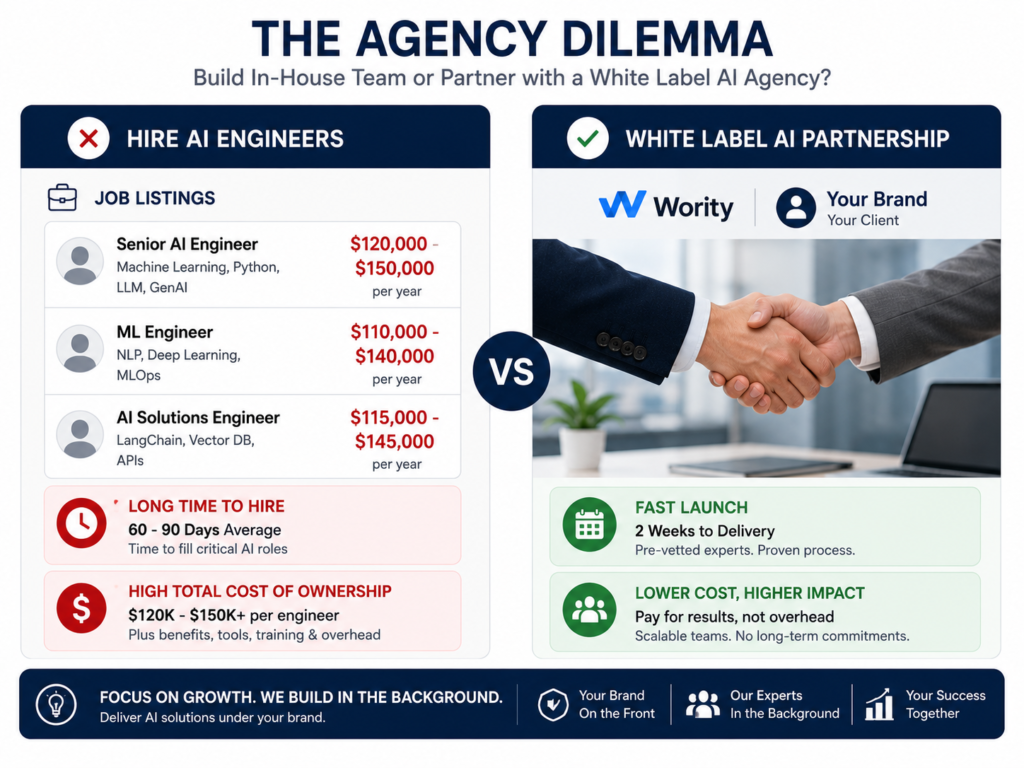
Digital agencies are in an awkward position in 2026. Clients expect them to have AI capabilities. The market talks about AI constantly. Competitors — including the large consultancies, the specialist AI startups, and the in-house teams of enterprise clients — are all moving.
But the economics of building an in-house AI delivery capability from scratch are difficult for most independent agencies to justify.
Promethean Research’s 2026 State of Digital Services report, a survey of 119 agency leaders, found the average agency earned a 13% net margin in 2025, with a third of the industry already running AI across the business and another 28% implementing it. An agency running at 13% net margin cannot absorb a $120,000 AI engineer hire speculatively — the revenue from that hire needs to exist before the hire is made, but the clients who would generate that revenue want to see the capability before they commission the work.
The alternative paths most agencies consider are not attractive either. Turning client AI projects down means handing that revenue to a competitor — often permanently, because a client who found another agency for their AI project is a client who discovered they could find another agency. Bringing in freelancers works once or twice but does not scale, does not build institutional knowledge, and creates inconsistent quality across projects. Stretching the existing team into territory they do not have expertise in produces mediocre outcomes that hurt the agency’s reputation rather than building it.
You have three options for adding AI to your service line: hire an internal team, outsource to a freelancer, or partner with a dedicated white label AI team. The first is expensive and slow. The second is inconsistent. The third is how the agencies in 2026 are actually doing it.
The white label model solves the dilemma structurally: the agency can accept AI projects, deliver them under its own brand at a margin that works commercially, and build a client relationship around AI delivery — without carrying the fixed cost of an AI engineering team between projects.
How the White Label AI Development Model Actually Works
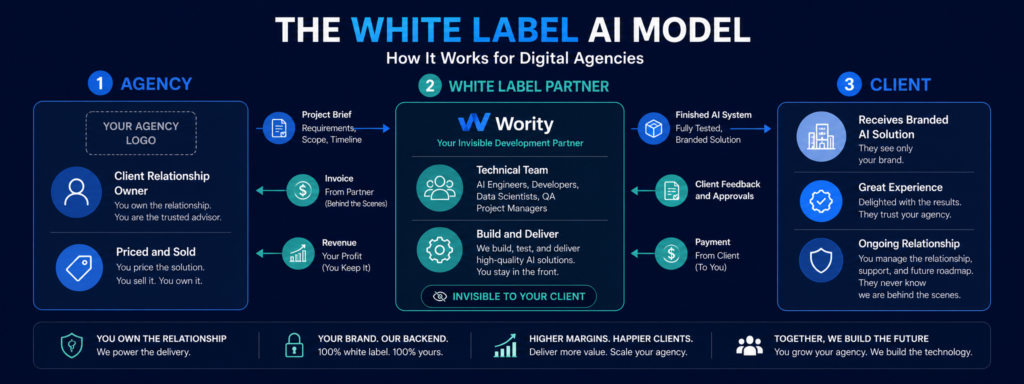
The model has three stages and one essential characteristic: the end client never knows a third party is involved.
Stage 1 — The Agency Sells:
The agency scopes the AI project with the client, agrees on the deliverable and price, and manages the client relationship throughout. All client communication, all project management, all presentations and reviews happen under the agency’s brand and through the agency’s team. The client receives proposals on the agency’s letterhead, progress updates from the agency’s project manager, and the finished AI system with the agency’s logo on it.
Stage 2 — The White Label Partner Builds:
The agency briefs the white label partner — a technical AI development team operating behind the scenes — with the project specification. The partner handles the strategy and architecture, the build and testing, the integration with the client’s existing systems, and the quality assurance. White Label IQ, for example, provides nine white label AI services for digital agencies: custom AI agents, workflow automation, legacy system integration, chatbot integration, AI-powered analytics dashboards, enterprise AI knowledge bases, AI-readiness audits, AI product photography, and AI video generation. Every service ships under the agency’s brand with no White Label IQ branding visible to clients. White Label IQ operates as an invisible extension of the agency.
Stage 3 — The Client Receives:
The finished AI system is delivered to the client under the agency’s brand. Training and handover documentation is prepared by the partner but branded by the agency. Ongoing support and maintenance is managed through the agency as the single point of contact.
The agency owns client communication, pricing, and the long-term relationship. The partner handles strategy, build, delivery, and support — entirely invisible to the client.
What makes this work commercially is the gap between the partner’s wholesale cost and the agency’s retail price. That gap is the agency’s gross margin. And for AI services in 2026, that gap is substantial.
The Five AI Services Agencies Are Reselling Most Profitably
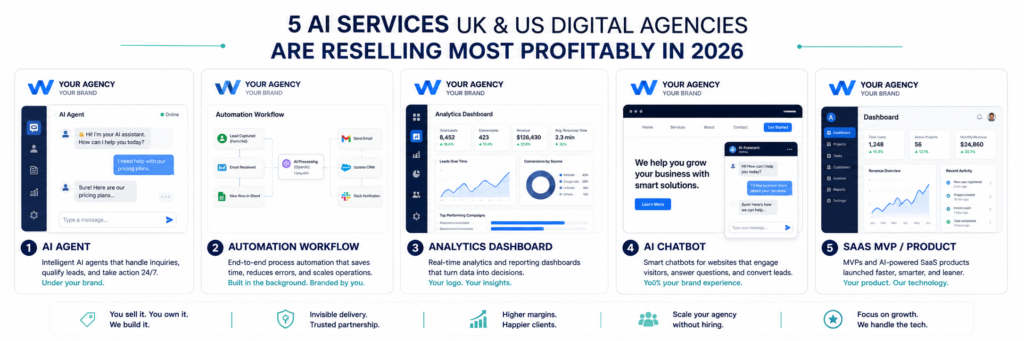
Strip away the branding question and white label AI comes down to four deliverables clients already pay for. AI changes who produces them, not what the client receives. The five services generating the best margins for agencies in 2026 are all variations on this principle.
Service 1 — Custom AI Agents for Client Operations
What it is: An autonomous AI system built specifically for the client’s workflow — lead qualification, customer support, appointment scheduling, document processing, invoice management. The agent integrates with the client’s existing tools (CRM, email, WhatsApp, ERP) and operates autonomously on the target workflow.
What the agency charges: $8,000 to $25,000 for a scoped build depending on complexity, plus $1,500 to $4,000 per month for ongoing optimisation and support.
What the white label partner costs: $3,000 to $10,000 build cost, $500 to $1,500 per month for maintenance.
Gross margin: 55 to 65% on the build, 55 to 70% on the ongoing retainer.
Why it is the highest-margin service: Every business has a repetitive workflow that AI can automate. The use case is not industry-specific, the ROI is measurable, and clients who see an AI agent working in production commission additional ones. A single custom agent build typically generates three to five subsequent projects from the same client.
Service 2 — AI Automation Workflows
What it is: Connected automation pipelines that link the client’s existing tools — their CRM, email platform, WhatsApp, accounting software, and project management system — through an AI orchestration layer that moves data and triggers actions automatically. The deliverable is a business process that runs without manual data transfer between systems.
What the agency charges: $5,000 to $18,000 build depending on the number of integrations and workflow complexity, plus $1,200 to $3,500 per month for maintenance.
What the white label partner costs: $2,000 to $7,000 build, $400 to $1,200 per month.
Gross margin: 55 to 65% throughout.
Why agencies lead with this service: It is visible to the client immediately. The moment the automation goes live and the client sees their CRM update automatically from a WhatsApp message, the value is obvious. It generates strong referrals because clients talk about visible operational improvements.
Service 3 — AI-Powered Reporting and Analytics Dashboards
What it is: A live-updating business intelligence dashboard that pulls data from the client’s marketing tools, financial system, CRM, and operational platforms — and presents it as an automated, branded report that the client can check in real time without anyone compiling it manually.
Client reporting is the most universally resold AI deliverable, because it is pure production work: pull data from Meta, Google Ads, GA4, and Search Console, explain what changed, send it under the agency letterhead.
What the agency charges: $3,000 to $12,000 build, $800 to $2,500 per month for data feeds and maintenance.
What the white label partner costs: $1,200 to $5,000 build, $300 to $900 per month.
Gross margin: 55 to 65%.
Why this service is particularly sticky: Once a client’s reporting is automated and live, they do not want to go back to monthly PDF reports. The monthly retainer for maintaining the dashboard creates predictable recurring revenue with very low churn.
Service 4 — AI Chatbot Development and Deployment
What it is: A conversational AI chatbot — website, WhatsApp, or internal knowledge base — built on the client’s specific data and integrated with their CRM, help desk, or product catalogue. The chatbot handles customer enquiries, qualifies leads, provides product information, or answers employee questions autonomously.
Chatbase enables agencies to create conversational AI assistants powered by client-specific data. CustomGPT.ai stands out as a premier white label AI platform designed for agencies that want to deliver intelligent, branded chatbot and automation solutions without coding.
What the agency charges: $4,000 to $15,000 build, $700 to $2,500 per month for training, maintenance, and optimisation.
What the white label partner costs: $1,500 to $6,000 build, $250 to $900 per month.
Gross margin: 55 to 65%.
Service 5 — AI SaaS MVP Development
What it is: A minimum viable AI-powered product built for clients who want to launch their own AI product — a SaaS tool for their customers, an internal AI application, or an AI feature layer added to an existing digital product. The white label partner builds the technical foundation; the agency manages the product strategy, client relationship, and go-to-market positioning.
What the agency charges: $20,000 to $80,000 for the build depending on scope, with ongoing development retainers.
What the white label partner costs: $8,000 to $35,000 build.
Gross margin: 50 to 60%.
Why this is the highest-revenue service: SaaS MVP builds are the largest single-project revenue generators available to agencies offering AI services. A single well-scoped SaaS MVP project generates more revenue than five standard website projects and keeps the client engaged for 12 to 24 months of iterative development.
The Margin Mathematics — What You Actually Earn
Jasper’s 2026 data shows that 50% of AI users report bringing work to market faster and 45% report lowered operating costs. For agencies, both of these translate directly into margin expansion and competitive differentiation.
Here is the honest margin arithmetic for a UK or US agency using a white label AI development partner.
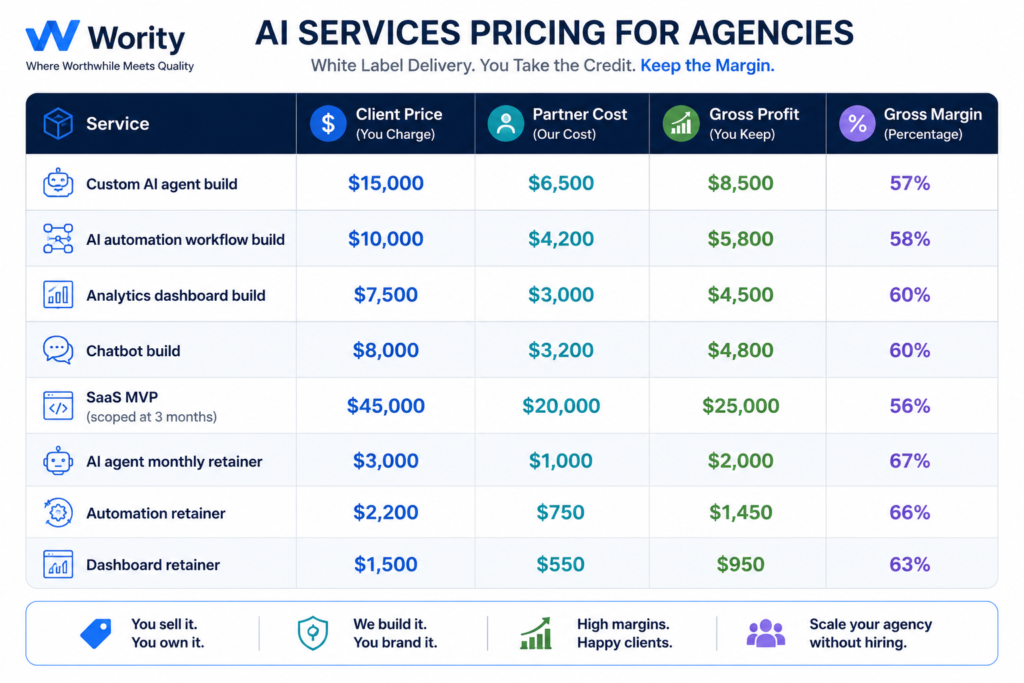
These margins compare favourably against typical agency gross margins on web development (40 to 50%), SEO retainers (50 to 60%), and paid media management (25 to 35%). The AI services column consistently runs 55 to 70% gross margin — the highest-margin service category most agencies have ever offered.
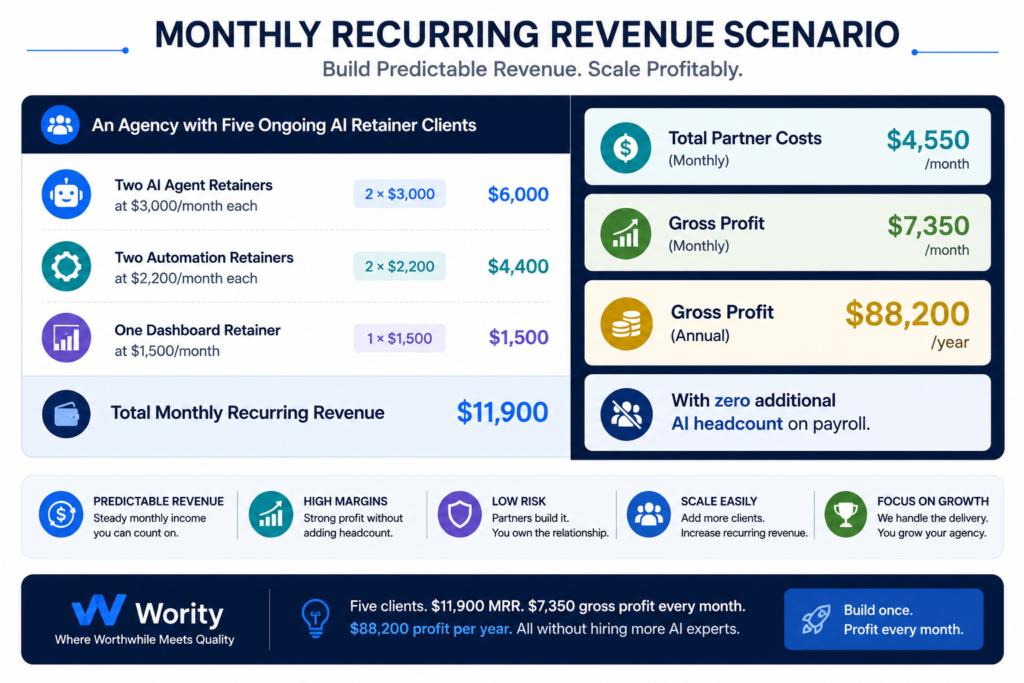
Compare this to what £88,200 in annual salary buys: one mid-level AI developer, before benefits and overhead. The white label model generates the same gross profit with none of the fixed cost, none of the recruitment risk, and none of the retention challenge.
How to Evaluate a White Label AI Development Partner
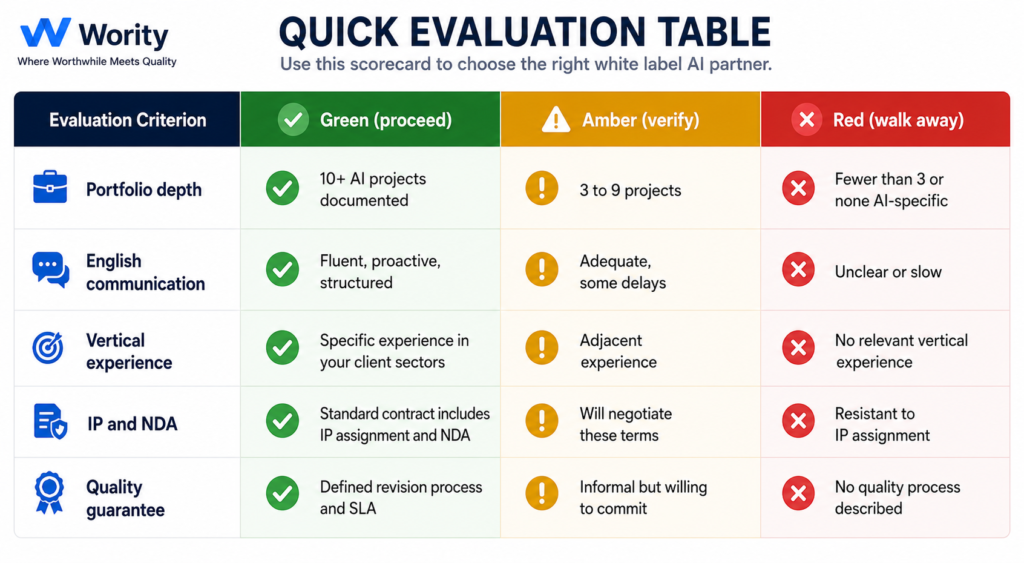
Not all white label AI partners are equivalent. The quality of your delivery — and therefore your client relationships — depends entirely on the quality of the partner you choose. These are the five criteria that separate reliable partners from unreliable ones.
Criterion 1 — Documented AI Delivery Portfolio
Ask for case studies of AI projects specifically — not web development, not general software development. Ask for examples of custom AI agents, automation workflows, or chatbots built under white label conditions. Verify that the examples are real by asking for a reference call with the agency that commissioned the work. A partner with 10 or more documented AI project completions is categorically lower risk than one proposing to add AI to their portfolio starting with your projects.
Look for partners booking Q3 2026 partner slots — a sign of genuine demand and capacity management rather than a partner who will accept any project regardless of their current delivery load.
Criterion 2 — English-First Communication Quality
Your agency will be managing the client relationship while the partner manages the build. Any communication friction between you and the partner creates project risk. Evaluate communication quality in the discovery call: are they responsive, clear, and precise in their written communication? Do they ask intelligent questions about your client’s requirements rather than just quoting immediately? Do they provide structured project updates proactively?
For agencies working with Indian white label partners — which offer the best combination of technical depth and cost among global options — assess English communication quality explicitly during evaluation. The right partner communicates at the same standard as a UK or US agency team.
Criterion 3 — Client Vertical Experience
AI systems for a UK FinTech client have different requirements to those for a US eCommerce brand. Ask whether the partner has delivered AI projects in your client’s specific vertical. A partner with relevant vertical experience understands the integration requirements, the compliance considerations, and the operational context that affect how the AI system is designed and built — reducing the discovery time and the risk of a build that technically works but does not fit how the client actually operates.
Criterion 4 — IP Ownership and Confidentiality Protections
Before sharing any client brief with a white label partner, confirm in writing that all intellectual property created in the project is owned by your agency (and therefore by your client), that the partner will not reuse code, models, or architectures developed for your client in other projects, that all client data shared during the build is kept confidential and not used for the partner’s own model training, and that the partner will sign a mutual NDA covering the white label relationship itself. Any partner who resists these terms is not structured for a professional white label partnership.
Criterion 5 — Replacement and Quality Guarantees
If the partner’s delivered work does not meet the agreed specification, what is the process? A credible white label AI partner offers a defined revision and remediation process with a maximum number of revision rounds before escalation, a replacement clause if the assigned developer is underperforming, and — for ongoing retainer relationships — a service level agreement covering response time and uptime for deployed AI systems. Partners who cannot describe these processes have not structured their business for reliable white label partnership.
Three Agency Scenarios: How the Model Plays Out in Practice

Scenario 1 — UK Web Agency, 12 People, London
Situation: A London web agency specialising in eCommerce development receives a brief from a fashion retailer client asking for an AI chatbot that handles customer service queries, recommends products, and integrates with their Shopify store and Zendesk helpdesk.
The agency has no AI engineering capability internally. The brief is worth £22,000 if delivered competently.
White label approach: The agency briefs a white label AI partner on the specification. The partner builds a Shopify-integrated product recommendation and customer service chatbot, connects it to the Zendesk ticket system, and delivers it under the agency’s branding. Partner cost: £9,000. Agency gross profit: £13,000. Gross margin: 59%.
Outcome: The agency delivers a project it would previously have turned down. The client is satisfied. The agency now has a documented AI chatbot case study in the eCommerce vertical. Three months later, the same client commissions an AI-powered inventory and demand forecasting tool — a £35,000 project.
Scenario 2 — US Marketing Agency, 20 People, Chicago
Situation: A Chicago digital marketing agency has five clients asking whether the agency can build them AI automation systems — specifically connecting their marketing tools (HubSpot, Meta Ads, Mailchimp) to their CRM and reporting dashboards to eliminate the manual reporting cycle.
The agency’s team has strong marketing strategy and account management skills. None of them can build the automation systems.
White label approach: The agency partners with a white label AI automation specialist. For each of the five clients, the agency scopes an automation workflow and reporting dashboard project, charges $8,500 to $12,000 per client for the build, and pays the partner $3,200 to $4,800 per build. Five projects generate $47,500 in revenue against $20,000 in partner costs — $27,500 gross profit in one quarter.
Each client then moves onto a $2,000/month retainer for ongoing dashboard maintenance and automation optimisation. Five retainers generate $10,000/month ($120,000/year) in recurring revenue at 65% gross margin.
Outcome: The agency adds $120,000 in annual recurring revenue without a single new hire, and converts five monthly retainer clients from project relationships to long-term embedded service relationships.
Scenario 3 — UK FinTech-Specialist Agency, 8 People, City of London
Situation: A specialist UK agency serving FinTech clients is asked to build a KYC document processing automation system for a regulated client — extracting data from identity documents, cross-referencing against sanctions databases, and updating the client’s CRM with verification status automatically.
The project requires both AI development expertise and understanding of FCA compliance requirements. The agency has the compliance knowledge but not the AI build capability.
White label approach: The agency partners with a white label AI partner experienced in regulated industry deployments. The partner builds the document extraction and database integration system; the agency manages the FCA compliance requirements, the client relationship, and the integration specification. Project price: £28,000. Partner cost: £11,500. Agency gross profit: £16,500. Gross margin: 59%.
Outcome: The agency delivers a complex, compliance-sensitive AI project that would have been impossible to deliver internally. The client extends the engagement to build three additional compliance automation modules. The agency develops a new service offering — AI compliance automation for UK FinTechs — without hiring a single additional team member.
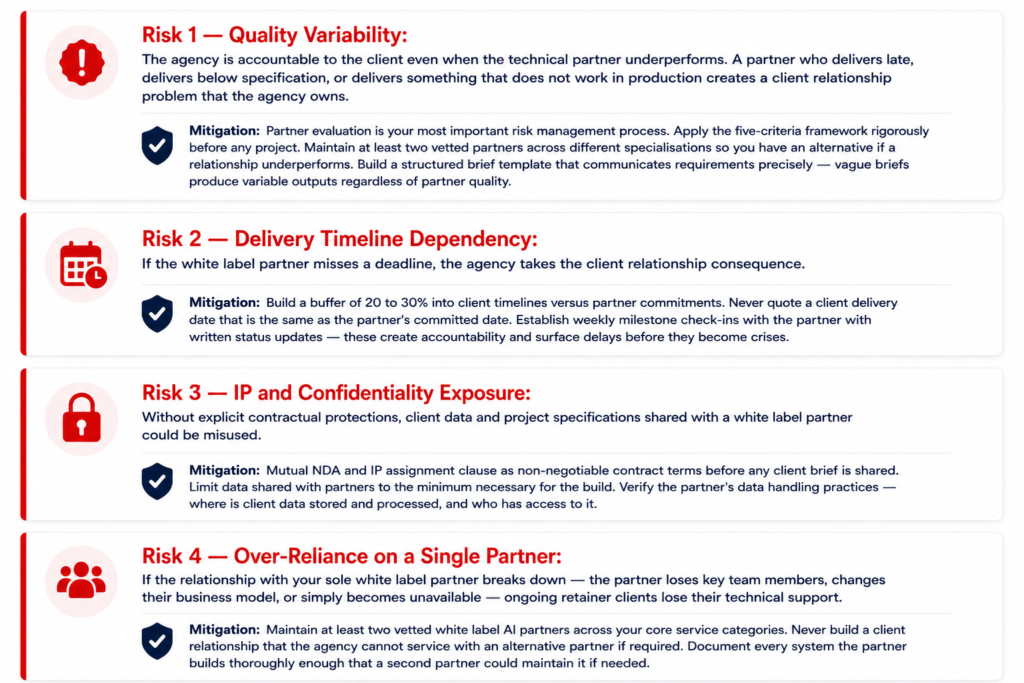
The Risks and How to Manage Them
White label AI development is not without risk. These are the four main risks and the specific mitigations that address each one.
The Opportunity: What Adding White Label AI Services Does for Agency Revenue
The AI marketing technology sector reached $107.5 billion in 2025, up from $15.8 billion in 2021. The white label market specifically is projected to reach $99.19 billion globally by end of 2026.
For the average UK or US independent agency running at 13% net margin on traditional services, the addition of white label AI services at 55 to 70% gross margin creates a material improvement in overall agency economics — without the overhead risk of additional headcount.
An agency generating £600,000 in annual revenue at 13% net margin earns £78,000 net profit. If that agency adds four AI automation retainers at £1,800/month and two AI agent retainers at £2,800/month — all white labelled — it adds £14,400/month in revenue (£172,800/year) at 65% gross margin, generating an additional £112,320 in annual gross profit against partner costs of approximately £60,480. After agency overhead allocation (estimated at 20% of new revenue), the net profit contribution is approximately £78,000 — effectively doubling the agency’s net profit from a standing start.
This is not a projection from an optimistic vendor’s deck. It is the straightforward arithmetic of high-margin service addition to an existing agency infrastructure, made possible by the white label model that eliminates the fixed cost of delivering those services.
The agencies building durable, high-margin businesses in 2026 are the ones treating AI not as a product to sell but as infrastructure for delivering more consistent, more measurable, and more scalable client results. White label AI services are the most accessible and most economically compelling path to that outcome for the vast majority of independent agencies operating today.
Conclusion — The Question Is Not Whether to Offer AI. It Is How to Deliver It.
Your clients are already asking about AI. Your competitors — at least the ones paying attention — are already working out how to deliver it. The window where you can observe from the sidelines without it affecting your client relationships is closing.
The question in 2026 is not whether to offer AI services. It is how to deliver them in a way that is commercially sustainable, operationally reliable, and builds your agency’s positioning rather than creating a dependency on a technology trend you do not have deep expertise in.
Agencies can offer AI services to their clients without hiring an AI team or learning another platform. We design and build custom AI agents, automations, plugins, and SaaS MVPs under your agency’s brand. You sell the service and keep the client relationship. We handle strategy, build, delivery, and support — invisible to your client.
White label AI development is how the agencies winning this transition are doing it. They are generating 55 to 70% gross margins on services their clients urgently want, without the fixed cost or the recruitment risk of building an in-house AI engineering team.
The model is not complicated. Find the right partner, evaluate rigorously, protect your client relationships with the right contractual terms, and start with one project. The margin arithmetic will tell you whether to do another.
Frequently Asked Questions About White Label AI Development for Agencies
Q: What is a white label AI development agency?
Q: What margin can a digital agency make on white label AI services?
Q: How do UK and US agencies find white label AI development partners?
Q: What AI services are UK and US agencies white labelling most profitably?
Q: What are the risks of white label AI development for agencies?
Q: How do agencies price AI projects delivered through white label partners?
Ready to Deliver AI Projects Under Your Agency's Brand?
Wority Technology is a white label AI development partner for UK and US digital agencies — we design and build custom AI agents, automation workflows, chatbots, analytics dashboards, and SaaS MVPs under your agency's branding, invisible to your clients. English-first communication, structured delivery process, IP assigned to your agency, and a partnership built for agencies that want to offer AI services without the overhead of an in-house engineering team.
Book a Free Partner Discovery CallSee Our White Label AI Services