The most expensive mistake in AI automation is not choosing the wrong vendor. It is choosing the wrong architecture level for your specific process.
A business that needs a single-agent automation and builds a multi-agent system has spent two to four times more than necessary, taken twice as long to go live, and created a maintenance burden that a simpler system would not have. A business that needs a multi-agent system and builds a single agent has capped its ROI and will hit limitations that require a rebuild within twelve months.
This post gives you the decision framework to get this right before any vendor conversation.
The Spectrum — From Basic Automation to Multi-Agent Orchestration
Think of AI automation as a spectrum, not a binary choice.
Level 0 — Rule-based automation: Fixed “if-this-then-that” logic. No AI judgment. Zapier, Make.com, n8n. Best for: connecting popular apps with consistent, predictable data. Cost: £500–£3,000 build, £20–£100/month running.
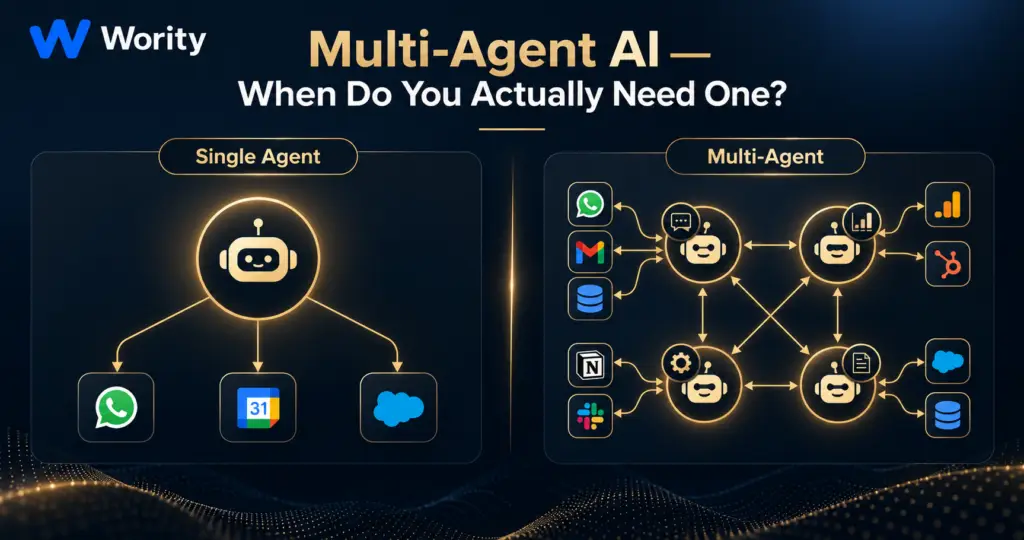
Level 1 — Single AI agent: One agent that handles a complete workflow end-to-end, making decisions at each step. Can read natural language inputs, classify intent, take multi-step actions across connected systems. Best for: high-volume single-process automation (inquiry → booking → confirmation → CRM update). Cost: £3,000–£10,000 build.
Level 2 — Multi-step orchestrating agent: One agent executing a complex workflow that spans multiple systems, multiple decision branches, and requires handling multiple exception paths. The logistics exception management case study (66 hrs/week saved) is a Level 2 build. Cost: £6,000–£20,000 build.
Level 3 — Multi-agent system: Multiple specialised agents working together. Each agent has a defined scope and passes outputs to the next agent in the workflow. Collectively they replace a coordination function that previously required one or more human coordinators. Cost: £15,000–£35,000+ build.
The Three Signals for Multi-Agent Architecture
You need a multi-agent system when all three of these are true:
Signal 1: The workflow crosses multiple functional domains simultaneously.
A single-domain workflow (customer enquiry → booking → confirmation) can be handled by one agent. A multi-domain workflow where the same trigger needs to simultaneously update the operations system, notify the finance team, update the client record, generate a report entry, and escalate to compliance — these parallel processing requirements exceed what a single agent handles cleanly. Multiple specialised agents, each responsible for one domain, coordinate through a shared orchestration layer.
Signal 2: Specialisation improves reliability or performance in each domain.
A single “generalised” agent handling customer communications, financial calculations, and compliance checking simultaneously performs less reliably than three specialised agents — one for each domain — with optimised prompting and context for their specific function. When errors in one domain would cascade into another, specialisation is worth the additional build cost.
Signal 3: You are replacing a coordination function, not a single task.
If you currently have a team member whose primary role is to move information between systems and make routing decisions — a dispatcher, a coordinator, an operations assistant — a multi-agent system is likely the right architecture to replace that coordination function. A single agent can handle one workflow. A multi-agent system can handle an entire coordination role.
The Three Signals for Single-Agent Architecture
You need a single agent (not multi-agent) when:
The workflow is linear and single-domain. A customer sends a WhatsApp message → the agent classifies, looks up context, responds, updates CRM, sends confirmation. This is one domain (customer communication) with a linear flow. A single agent handles this cleanly.
The trigger is one event type. Every incoming call gets the same general handling. Every new inquiry gets the same qualification flow. Every exception follows the same classification and notification path. Single event type, single agent.
Speed-to-value matters more than comprehensive automation. If you need to demonstrate ROI within six weeks and your budget is under £10,000, a single-agent automation is almost always the right starting point. Get it running, measure the result, then build the next layer.
The Staged Approach — Why Most SMEs Should Start at Level 1
SMEs are often better positioned than larger organisations to adopt agentic AI because they face fewer legacy system constraints.
This advantage applies at Level 1 specifically. Smaller businesses can move from scoping to go-live in three to five weeks for a Level 1 agent, measure the result, and use that data to justify the next build. This staged approach:
– Reduces initial investment risk
– Produces measurable ROI data that justifies the next level
– Builds team familiarity with automation outputs before adding complexity
– Identifies integration issues at a single-system level before multi-system coordination
Wority recommends starting at Level 1 for every new automation client — unless the business case for Level 2 or Level 3 is unambiguous from the process documentation.
A Real Architecture Decision — Logistics Company (2026)
The Dubai logistics company in the case study earlier in this series needed a Level 2 build (multi-step orchestrating agent), not Level 3 (multi-agent). Here is why:
The trigger was one event type: a delivery exception in the TMS. The workflow then branched into multiple parallel actions: client notification, TMS update, finance flagging, reporting log. But all these actions were triggered by the same event and followed a consistent pattern.
A single multi-step orchestrating agent could handle all the branches from one trigger. A full multi-agent system would have added build complexity and cost without proportional performance improvement for this specific workflow.
If the business had wanted to simultaneously manage: exception handling (the current system) + proactive client communication sequences + subcontractor performance reporting + financial reconciliation as four separate ongoing workflows — then a multi-agent system would have been the right architecture.
The decision framework: start with what the process actually requires. Not with what sounds most impressive.
Q1: What is the difference between a single agent and a multi-agent AI system?
Q2: When is a rule-based automation sufficient instead of an AI agent?
Q3: How much more does a multi-agent system cost than a single agent?
Q4: Can I start with a single agent and upgrade to multi-agent later?
Not sure which level your process needs?
Book a free 30-minute scoping call. We will map your process against the decision framework and tell you exactly what architecture is right — and what it will cost.
Book a free 30-minute scoping call