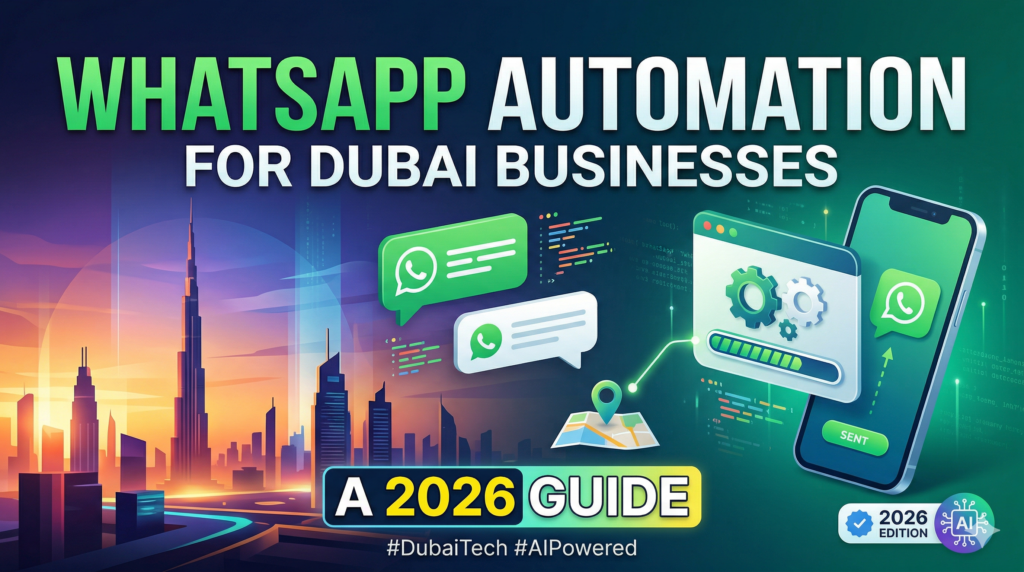
WhatsApp Automation for Dubai Businesses: A 2026 Guide
Your Dubai customer does not want to fill a form, wait for an email reply, or sit on hold. They want to send one WhatsApp message and get an answer in seconds. That is not an expectation. That is the standard. WhatsApp is used by more than 85 percent of UAE residents on a daily basis, making it by far the dominant communication channel across Dubai, Abu Dhabi, Sharjah, and the wider GCC. For businesses, this means something remarkable: your customers are already waiting on a single platform, checking it constantly, expecting instant responses, and ready to buy, book, or enquire the moment you reply. The problem is that responding instantly to every customer, every hour of the day, in multiple languages, across dozens of conversations simultaneously is not possible with human staff alone. This is where WhatsApp automation comes in. Businesses across Dubai — from real estate agencies in Business Bay to hotel chains in Downtown, from eCommerce brands targeting international buyers to healthcare clinics serving a diverse multilingual population — are deploying WhatsApp automation to handle customer conversations at scale, generate and qualify leads automatically, and build the kind of responsive, always-on customer experience that converts first contacts into loyal clients. This guide covers everything a Dubai business needs to know about WhatsApp automation in 2026: why it matters here more than anywhere else, how the technology works, which use cases are delivering the strongest ROI, what compliance requirements apply in the UAE, and how to get started without overcomplicating it.Why WhatsApp Is the Most Important Channel for Dubai Businesses
Dubai is one of the most digitally connected cities in the world. Smartphone penetration in the UAE sits above 95 percent. WhatsApp penetration exceeds 80 percent of the adult population across the UAE, Saudi Arabia, and Qatar, making the Gulf region one of the most WhatsApp-saturated markets anywhere on earth. What this means for business communication is simple: your customer base is on WhatsApp, and they expect to communicate with businesses the same way they communicate with family and friends — through a real-time chat conversation that feels personal, immediate, and frictionless. WhatsApp messages achieve open rates of 90 to 98 percent. Compare that to email, where the average open rate sits around 21 percent. When you send a WhatsApp message to an opted-in customer in Dubai, it is almost certainly going to be read — and read within minutes. In a competitive market where attention is the scarcest resource, that level of reliable reach changes the economics of customer communication entirely. WhatsApp-sourced leads also convert at 3.2 times the rate of equivalent form submission leads, according to analysis by Hyperleap AI across their UAE business customers. A chat conversation is an ongoing relationship. A form submission is a one-time data capture. The difference in conversion behaviour reflects a fundamental difference in how the customer experiences the interaction. For businesses in Dubai's most competitive sectors — real estate, hospitality, luxury retail, healthcare, and automotive — WhatsApp is not a supplementary channel. It is the primary commercial relationship channel. Getting WhatsApp automation right is not a nice-to-have in 2026. It is a strategic necessity.WhatsApp Business App vs WhatsApp Business API: Which Does Your Business Need?
The first decision every Dubai business needs to make is which version of WhatsApp Business to use. There are two, and they serve very different needs. H3: WhatsApp Business App — Best for Small Businesses Just Getting Started The WhatsApp Business App is a free application available on Android and iOS. It gives small businesses a professional business profile, basic automated messages (greeting messages for new contacts, away messages for out-of-hours enquiries), quick reply shortcuts for frequently asked questions, and a product catalogue to showcase offerings inside the chat. It is ideal for a boutique retailer with low message volume, a solo consultant, or a small service business taking its first steps in WhatsApp customer communication. It supports up to four linked devices, which is sufficient for a small team. What it cannot do: send bulk broadcasts to large lists, integrate with CRM systems, run complex automation workflows, support multiple agents on the same account at scale, or access advanced analytics. For a growing Dubai business with significant customer message volume, these limitations quickly become barriers.WhatsApp Business API — The Engine Behind Serious Automation
The WhatsApp Business API (also called the WhatsApp Cloud API) is the platform that enables true automation at scale. It is what powers the sophisticated WhatsApp experiences that leading Dubai businesses are building in 2026 — automated chatbots that handle customer conversations around the clock, bulk broadcast campaigns sent to thousands of opted-in customers simultaneously, CRM integration that updates customer records in real time, multi-agent team inboxes where dozens of sales or support staff manage conversations through a single shared interface, and advanced analytics that track message delivery, open rates, response rates, and conversion outcomes. The WhatsApp Business API has grown at more than 40 percent year on year in terms of active API accounts globally. 80 percent of large enterprises worldwide are projected to adopt the API by 2025. In the UAE and GCC, the pace of adoption is even faster. To access the WhatsApp Business API, businesses must work with an official Meta-approved WhatsApp Business Solution Provider (BSP). The BSP handles the technical integration, account verification, template approval, and compliance requirements. This is not optional — businesses cannot access the API directly without going through an approved partner. The pricing model for the API in the UAE is per conversation. Marketing messages in the UAE cost approximately AED 0.16 per conversation. Utility and customer service conversations have different rates. The cost structure is designed to make high-volume messaging economically viable for businesses with serious customer communication needs.The 6 Most Powerful WhatsApp Automation Use Cases for Dubai Businesses
Dubai businesses that are generating the strongest returns from WhatsApp automation share a consistent pattern: they started with a specific, high-volume use case, proved ROI quickly, and then expanded. Here are the six use cases delivering the most measurable results in 2026.
1. Lead Generation and Qualification — Real Estate, Automotive, Education
Dubai's real estate market is one of the most competitive and internationally diverse in the world. Agents handle enquiries from buyers and investors across dozens of nationalities, communicating in Arabic, English, Hindi, Urdu, Russian, and more — often simultaneously, often outside business hours. A Dubai real estate agency that deployed WhatsApp automation reported converting website visitors to qualified leads at three times their previous rate. The automation handled the initial conversation — capturing buyer requirements, budget range, preferred location, and timeline — and delivered a curated shortlist of matching properties within minutes of the enquiry, before routing the qualified lead directly to the right agent. The agent arrives at the conversation already knowing what the customer wants. Developers on Saadiyat Island, Yas Island, and Al Reem Island are running multilingual WhatsApp broadcasts in English, Arabic, Hindi, Urdu, and Russian for off-plan launches, sending virtual tours and ROI analyses via WhatsApp, and managing the complete investment process from enquiry through to handover — all within the platform. For the automotive sector, WhatsApp automation handles test drive bookings, finance pre-qualification, and model comparisons at scale. For education — one of Dubai's fastest-growing service sectors — automated WhatsApp flows manage enquiry handling, course information delivery, application follow-ups, and enrolment confirmations without requiring admissions staff to handle every initial contact manually.2. Customer Support Automation — Retail, eCommerce, Healthcare
Dubai's customer service challenge is the diversity of its population. With over 200 nationalities living and working across the emirate, businesses face customer enquiries in multiple languages at all hours of the day and night. Hiring multilingual support staff to cover this costs AED 55,000 to 75,000 monthly for a team capable of handling Arabic, English, Hindi, and Tagalog. An AI-powered WhatsApp automation system handles all of these languages automatically at a fixed monthly platform cost. A Dubai fashion retailer with 600 daily customer enquiries deployed WhatsApp automation and saw the system handle 72 percent of all incoming conversations automatically — tracking orders, answering product questions, processing return requests, and confirming delivery details without any human involvement. Their support team reduced from five people to two. They saved AED 24,000 monthly on staffing costs alone, generating a 197 percent ROI in the first year. AI-powered chatbots save global enterprises approximately 7 billion business hours annually by the end of 2026. For individual Dubai businesses, the impact is immediate and measurable from the first month of deployment.3. Appointment Booking and Reminders — Clinics, Salons, Hotels, Restaurants
In Dubai's service-intensive economy, missed appointments cost real money. A WhatsApp automation system that sends booking confirmations, pre-appointment reminders, and easy rescheduling options dramatically reduces no-show rates — with most deployments reporting improvements of 25 to 35 percent. Dubai clinics, dental practices, beauty salons, and medical centres are deploying WhatsApp bots that handle the complete booking cycle: receiving the appointment request, checking availability, confirming the slot, sending reminders 24 hours and 2 hours before the appointment, and following up with a satisfaction check and rebooking prompt after the visit. The patient or client experiences a seamless, responsive service. The clinic recovers staff time that was previously consumed by phone calls and manual confirmation messages. For restaurants and cafes — a highly competitive sector in Dubai — WhatsApp automation handles table reservations, special occasion requests, takeaway orders, and delivery tracking updates. Customers who book and order through WhatsApp show higher average transaction values and stronger return visit rates than those using third-party booking platforms, because the WhatsApp conversation builds a direct ongoing relationship between the customer and the business.4. WhatsApp for Hospitality — Dubai Hotels and Guest Services
WhatsApp is the operational communication rail for Dubai's hotel industry. Guests expect to be able to message a hotel about late checkout, room service, transport bookings, and local recommendations the same way they message friends — and they expect an immediate response regardless of what time it is. Dubai hotels implementing WhatsApp automation through AI-assisted guest messaging are reporting 50 to 90 percent reductions in administrative workload on guest-facing tasks, with Year-1 ROI of 3x to 5x when back-office workflows are connected end to end. The system answers policy questions, sends billing links for card-on-file payments, processes late checkout requests, and handles pre-arrival instructions and in-stay service requests — without requiring the front desk to manually manage each interaction. Dubai's Department of Economy and Tourism's D33 agenda explicitly funnels investment toward smart-city infrastructure and service productivity. Hotels that align their WhatsApp automation strategy with the D33 framework are not just cutting costs — they are positioning their operations as part of Dubai's broader digital transformation narrative, which carries commercial value in attracting international investors and management brands.5. Broadcast Campaigns and Re-engagement — Retail, eCommerce, F&B
WhatsApp's 98 percent message open rate makes it the most effective direct marketing channel available for Dubai businesses today. For context, that is roughly five times the open rate of email and significantly higher than any social media platform's organic reach. WhatsApp broadcast campaigns through the API allow businesses to send personalised messages to thousands of opted-in customers simultaneously — product launches, limited-time offers, event invitations, seasonal promotions, and re-engagement campaigns for customers who have not purchased recently. Unlike social media posts that compete in an algorithm-controlled feed, a WhatsApp message goes directly into the customer's personal messaging inbox where it is almost guaranteed to be seen. One Unilever campaign using an AI-powered WhatsApp chatbot for personalised product recommendations resulted in a 138 percent increase in direct sales. In Dubai's luxury retail, automotive, and F&B sectors — where relationship-based selling and personal touch are commercial differentiators — the ability to reach customers personally at scale through WhatsApp creates a level of commercial leverage that no other channel matches. The key compliance requirement: every recipient must have explicitly opted in to receive WhatsApp marketing messages from your business. List building through genuine consent — website opt-in forms, checkout prompts, in-store sign-ups — is the foundation of any effective WhatsApp broadcast strategy.6. Payment Reminders, Order Updates, and Transaction Notifications
Beyond marketing and support, WhatsApp automation handles the transactional communication that keeps business operations running smoothly. Payment reminders sent via WhatsApp achieve dramatically higher response rates than email or SMS alternatives. Order confirmation and delivery tracking updates sent through WhatsApp reduce "where is my order" customer service enquiries by 40 to 60 percent. For property management companies in Dubai handling maintenance requests, rent reminders, and tenant communications across large portfolios, WhatsApp automation has become the operational backbone of tenant relationship management — delivering faster resolution times, higher tenant satisfaction, and significantly reduced administrative overhead compared to email or portal-based communication systems.WhatsApp Compliance in the UAE: What Every Business Must Know
WhatsApp automation in the UAE operates under both Meta’s platform policies and the UAE’s own data protection regulations. Non-compliance creates two separate risks: account suspension by Meta, which immediately shuts down your entire WhatsApp business operation, and legal exposure under UAE data law. Neither is acceptable. Here is what Dubai businesses need to understand before deploying.
Meta's January 2026 Compliance Update
Meta implemented a significant policy update in January 2026 that directly affects how businesses can use AI automation on the WhatsApp Business API. The update specifically bans open-ended, general-purpose AI chatbots — the kind that can hold free-form conversational AI discussions like a general AI assistant. What is permitted is structured, predictable, business-purpose automation: order management bots, appointment scheduling flows, support ticket resolution, lead qualification sequences, and similar defined workflows. This means businesses building WhatsApp automation in 2026 need to ensure their chatbot follows structured, predefined conversation flows rather than attempting to replicate a general conversational AI experience. Non-compliance results in account suspension and operations coming to a complete halt. Work only with BSPs who are up to date on these requirements and build accordingly.UAE Data Protection Law (PDPL) Requirements
The UAE Personal Data Protection Law requires businesses to obtain explicit, informed consent before collecting, storing, or processing any personal data — including data collected through WhatsApp conversations. This means every WhatsApp automation deployment must include a clear opt-in mechanism, a privacy notice explaining how data will be used, and a straightforward way for customers to withdraw consent and be removed from your communication list. For businesses operating across Dubai's free zones, separate data protection frameworks may apply depending on jurisdiction — DIFC (Dubai International Financial Centre) and ADGM (Abu Dhabi Global Market) have their own data protection regimes that are broadly aligned with GDPR. Healthcare businesses must also comply with UAE Health Data Law requirements for any patient information handled through WhatsApp. The practical implication: build consent workflows into your WhatsApp automation from day one. Do not treat compliance as a phase-two consideration. The audit trail for consent is your protection against both regulatory exposure and Meta account suspension.VoIP Restrictions and What They Mean for WhatsApp
The UAE restricts WhatsApp voice and video calls as part of its broader VoIP regulation policy. This affects some aspects of WhatsApp functionality for personal use but does not impact the WhatsApp Business API’s core automation, broadcast, and chatbot capabilities. Business messaging and automation through the API are fully operational in the UAE. Build your automation strategy around the messaging and automation capabilities that are available and fully functional, not around VoIP features that face regulatory restrictions.
The ROI of WhatsApp Automation — Real Numbers for Dubai Businesses
Dubai businesses deploying WhatsApp automation are reporting ROI figures that would be difficult to achieve through any other single technology investment. Here are the concrete performance benchmarks from real deployments: Lead generation: WhatsApp-captured leads convert at 3.2 times the rate of form submission leads. Businesses using WhatsApp chatbots for lead capture report lead generation increases of over 500 percent compared to traditional channels. AI-driven WhatsApp interactions achieve an average lead conversion rate of 28 percent. Customer support cost reduction: Businesses handling customer enquiries through WhatsApp automation report support cost reductions of 30 to 50 percent, with the automation rate for routine enquiries typically reaching 60 to 80 percent. A five-person Dubai support team handling 600 daily enquiries reduced to two people after automation, saving AED 24,000 per month with 197 percent Year-1 ROI. Message engagement: 98 percent open rate versus 21 percent for email. The vast majority of WhatsApp messages are read within five minutes of delivery. In Dubai's competitive market where response speed is a direct revenue driver, this level of engagement is commercially transformative. Operational efficiency: Dubai hospitality businesses report 50 to 90 percent reductions in administrative workload on WhatsApp-managed guest interactions. Automation campaigns through WhatsApp API show 25 percent higher conversion rates on cart recovery and booking reminder workflows compared to equivalent email campaigns. Revenue impact: A 138 percent increase in direct sales was reported from one AI-powered WhatsApp personalised recommendation campaign. Dubai agencies using WhatsApp automation for broadcast campaigns report ROI improvements of 30 percent revenue increase, 54 percent more leads, and three times higher marketing productivity compared to pre-automation performance. These numbers reflect a fundamental truth about WhatsApp automation in the Dubai market: the combination of near-universal platform adoption, exceptional message engagement rates, and the commercial premium on responsiveness in a relationship-driven business culture creates conditions where well-executed WhatsApp automation generates returns that are difficult to replicate through any other channel.The Multilingual Advantage — Serving Dubai's Diverse Market
Dubai's population of over 3.5 million includes more than 200 nationalities. The city's workforce and customer base communicate in Arabic, English, Hindi, Urdu, Tagalog, Russian, and dozens of other languages. This linguistic diversity is one of the most distinctive and commercially significant characteristics of the Dubai market — and it is one that WhatsApp automation handles better than almost any other technology solution. AI-powered WhatsApp chatbots detect the language of the incoming message and respond in the same language automatically, without requiring separate bot configurations for each language or separate human staff for each language group. A customer who messages in Hindi receives a reply in Hindi. A customer who messages in Russian receives a reply in Russian. The same automation handles all of them simultaneously, with the same quality and speed of response. For a Dubai business relying on human staff alone, providing this level of multilingual service would require building a team capable of handling at least four or five languages simultaneously — at a cost of AED 55,000 to 75,000 per month for adequate coverage. An AI-powered WhatsApp automation system delivers this at a fraction of the cost, with no staffing overhead, no leave coverage gaps, and no quality variation between agents. Building your WhatsApp business profile in both English and Arabic is considered best practice in Dubai regardless of the automation layer you use. Arabic is the official language of the UAE and communicates a level of cultural respect and local commitment that resonates strongly with Emirati and Arab customers.How to Get Started With WhatsApp Automation in Dubai
Starting WhatsApp automation in Dubai is significantly more straightforward than most business owners expect. Here is the practical roadmap.
Step 1 — Set Up a Professional WhatsApp Business Profile
Before any automation, your WhatsApp Business profile is the foundation. Include your business name, physical address in Dubai, operating hours, website link, and a clear service description. Write it in both English and Arabic. Upload a clean, professional logo as your profile image. This profile is the first thing a customer sees when your message arrives — make it communicate legitimacy, professionalism, and UAE presence.
Step 2 — Choose Your Path: App or API
If your business handles fewer than 50 customer conversations per day, start with the WhatsApp Business App and its built-in automation features: greeting messages, away messages, and quick reply shortcuts. This costs nothing and gets you operational in hours. If your business handles more volume than that, or if you need CRM integration, multi-agent team access, broadcast campaigns, or sophisticated chatbot flows, you need the WhatsApp Business API. Choose an official Meta-approved BSP that operates in the UAE, has documented compliance with the January 2026 policy updates, and offers genuine local support. Setup typically takes one to four weeks depending on the complexity of your integration requirements.Step 3 — Build Consent Into Your List From Day One
Before you can send any marketing message through WhatsApp, every recipient must have opted in. Build opt-in prompts into every customer touchpoint: your website contact page, your checkout flow, your physical store sign-up form, your Instagram bio link. The explicit consent of your customer base is the asset that makes your WhatsApp automation commercially valuable. Buying contacts, scraping data, or messaging people without consent results in account suspension and UAE data law exposure.
Step 4 — Start With One High-Impact Automation
Do not try to automate everything simultaneously. Pick the single workflow that will have the most immediate commercial impact on your specific business: For real estate: an automated lead qualification flow that captures buyer requirements and delivers property shortlists within minutes of an enquiry. For eCommerce: an order confirmation and delivery tracking automation that eliminates "where is my order?" support volume. For clinics and salons: an appointment booking, confirmation, and reminder flow that reduces no-shows by 25 to 35 percent. For hotels and hospitality: a guest messaging automation that handles pre-arrival, in-stay requests, and post-checkout follow-up. For retail: a broadcast campaign to opted-in customers announcing new arrivals, exclusive offers, or seasonal promotions. Run this one automation for 60 to 90 days. Measure message open rate, response rate, lead conversion, no-show rate change, or support cost reduction depending on what your use case targets. Use the results to build the business case for expanding to additional automation flows.Step 5 — Connect WhatsApp to Your CRM
The full value of WhatsApp automation is unlocked when your conversations connect to your customer relationship management system. Every lead captured through a WhatsApp automation flow should be automatically synced to your CRM with the conversation transcript, contact details, and qualification data. Every support interaction should update the customer record with the issue and resolution. Every broadcast campaign response should be tracked against purchase history and customer lifetime value. This integration layer is what transforms WhatsApp from a communication channel into a revenue intelligence system — giving you the data to understand which campaigns work, which customer segments convert best, and where your automation flows need to be refined.Common Mistakes Dubai Businesses Make With WhatsApp Automation
Messaging without consent. This is the single most common and most damaging mistake. Sending unsolicited messages to contacts who have not opted in to hear from your business will trigger customer complaints, damage your sender reputation score with Meta, and risk account suspension. There are no shortcuts to building a legitimate, opted-in WhatsApp contact list. Using the WhatsApp Business App for enterprise-scale needs. A growing Dubai business that keeps adding team members to a single WhatsApp Business App account is creating coordination chaos, missing messages, and leaving revenue on the table. The App was not built for enterprise scale. When your message volume justifies it, move to the API. Treating WhatsApp like email. WhatsApp messages are personal. They arrive in the same inbox as messages from family members. Sending broadcast messages that feel like mass email newsletters, use formal corporate language, or ignore the conversational nature of the platform will result in customers blocking your number and reporting your business. Keep WhatsApp communication concise, valuable, personal, and responsive to replies. Building bots that do not hand off to humans. Automation handles routine, predictable conversations exceptionally well. Complex queries, emotionally sensitive situations, and high-stakes decisions require a human agent. Every WhatsApp automation system deployed in Dubai should have a clear, well-designed escalation path that smoothly hands the conversation to a human when needed — not a dead end that leaves the customer waiting in an automated loop with no way out. Ignoring the January 2026 Meta policy update. Businesses that deployed open-ended conversational AI chatbots before the January 2026 update and have not updated their flows to comply with the new structured automation requirements are at risk of account suspension. Review your chatbot flows against the current policy and update accordingly.The Market Opportunity — Why 2026 Is the Right Time to Move
By 2026, WhatsApp chatbots are projected to save 2.5 billion hours of global business time annually. Industries including retail, banking, and healthcare are projected to save $11 billion collectively through chatbot automation. The WhatsApp Business API is growing at more than 40 percent year on year in active accounts. In the Gulf specifically, official WhatsApp Business Solution Providers estimate that by 2030, the API will move 60 percent of all B2C communications in the region. That is not a distant forecast — it is a trajectory already visible in the adoption rates of Dubai's leading businesses across every sector. The businesses deploying WhatsApp automation in 2026 are not ahead of the curve. The early adopters have already moved. What 2026 represents is the mainstream adoption window — the period where businesses that implement now capture competitive advantage before WhatsApp automation becomes the universal baseline expectation of every customer in the UAE market. Dubai's customers have already decided they want to communicate through WhatsApp. The question for every Dubai business in 2026 is whether they will meet that expectation with an automated, always-on, intelligent system that converts those conversations into revenue — or whether they will keep relying on manual responses that are too slow, too inconsistent, and too expensive to scale.Conclusion — WhatsApp Automation Is Not a Feature. It Is Your Front Desk.
In Dubai, business is relationship-driven. Trust is built through responsiveness, consistency, and personal attention. WhatsApp automation does not replace those values — it enables them to operate at a scale that no human team alone can sustain. When a property buyer from Moscow messages your Dubai real estate agency at 11pm on a Friday, an automated WhatsApp flow responds in Russian within seconds, captures their requirements, sends matching property videos, and queues their contact for your agent's Monday morning call — already qualified and already engaged. When a patient in Dubai Marina tries to rebook a clinic appointment during Ramadan evening hours, your WhatsApp automation handles the rebooking instantly and sends a confirmed reminder, while your clinic team focuses on the patients in front of them. When 3,000 opted-in customers receive a personalised WhatsApp message about your new product launch at the optimal send time based on their past engagement behaviour, 98 percent of them read it within five minutes and your conversion rate is five times what any email campaign has ever delivered. That is the business case for WhatsApp automation in Dubai in 2026. It is not a chatbot. It is not a marketing tool. It is your always-on, multilingual, personalised front desk — working every hour, handling every conversation, and moving every customer one step closer to conversion while your human team focuses on the relationships and decisions that genuinely require them.Ready to Build WhatsApp Automation for Your Dubai Business? Wority Technology builds custom WhatsApp automation solutions for businesses across the UAE and GCC — from initial API setup and chatbot design to CRM integration, multilingual conversation flows, and ongoing optimisation. We handle the technical complexity so you can focus on converting the conversations into revenue. Visit www.woritytechnology.com to discuss your WhatsApp automation project today.Frequently Asked Questions About WhatsApp Automation in Dubai
Is WhatsApp Business available in the UAE?
Yes. WhatsApp Business — both the App and the Business API — is fully available in the UAE for business messaging and automation purposes. Note that WhatsApp voice and video calling features face VoIP restrictions in the UAE, but these do not affect the business messaging, chatbot, and automation capabilities that the WhatsApp Business API provides.
How much does WhatsApp Business API cost in the UAE?
WhatsApp Business API pricing in the UAE is charged per conversation. Marketing conversations (outbound messages your business initiates) cost approximately AED 0.16 per conversation. Utility conversations and customer service conversations have different pricing tiers. Businesses also pay for the WhatsApp BSP platform they use to access the API, typically starting from AED 500 to 2,500 monthly depending on features, message volume, and provider.
What is a WhatsApp BSP and do I need one in Dubai?
A WhatsApp Business Solution Provider (BSP) is a Meta-approved company that provides businesses with access to the WhatsApp Business API. Businesses in Dubai cannot access the API directly — they must work through an approved BSP. The BSP handles account verification, template message approval, technical integration, and compliance with Meta’s platform policies including the January 2026 updates. Always verify that your BSP is officially listed as a Meta partner.
Is WhatsApp automation GDPR and UAE data law compliant?
WhatsApp automation can be fully compliant with UAE data protection law (PDPL) and with DIFC and ADGM data protection frameworks when implemented correctly. Compliance requires obtaining explicit opt-in consent before messaging contacts, maintaining a clear privacy notice, offering customers a simple way to withdraw consent, and ensuring all customer data is stored in accordance with UAE data residency requirements. Healthcare businesses must additionally comply with UAE Health Data Law requirements for patient information.
Which industries use WhatsApp automation most in Dubai?
The industries with the highest WhatsApp automation adoption in Dubai are real estate (lead generation, property showcasing, investor communication), hospitality (guest services, concierge automation, booking management), eCommerce and retail (order updates, customer support, broadcast marketing), healthcare (appointment booking, reminders, patient communication), automotive (test drive bookings, finance pre-qualification), and education (admissions enquiries, enrolment management).
How long does it take to set up WhatsApp automation in Dubai?
For businesses using the WhatsApp Business App with basic automation features (greeting messages, away messages, quick replies), setup takes a few hours. For businesses implementing the WhatsApp Business API with chatbot flows, CRM integration, and broadcast campaign capabilities, the typical implementation timeline is one to four weeks from contract to go-live, depending on the complexity of the integrations required and the number of conversation flows to be built and tested.
