
AI Automation for Australian Logistics Companies: The 2026 Operations Guide
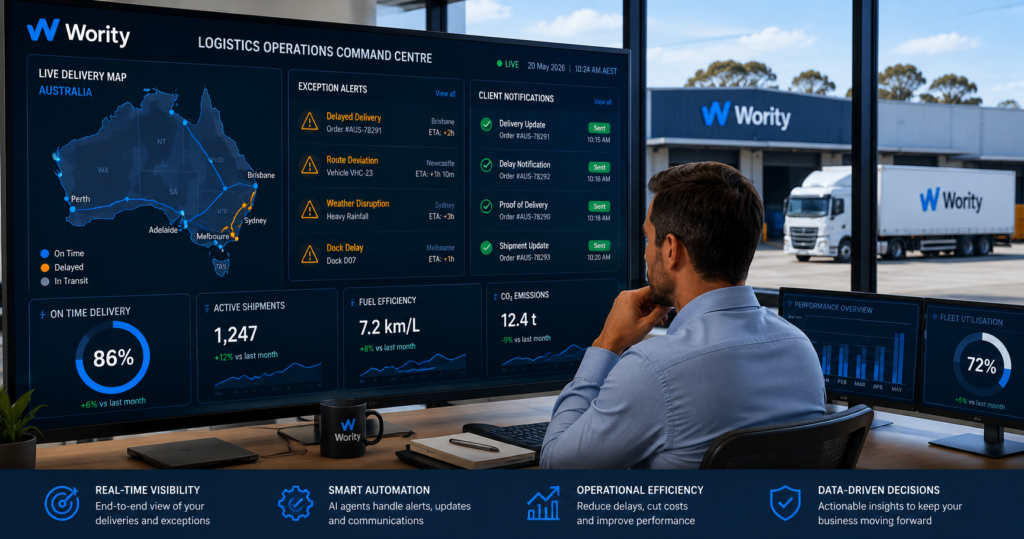
AI automation for Australian logistics companies is no longer a future planning exercise. It is a cost control decision being made right now — by operators in Sydney, Melbourne, Brisbane, and Perth who are watching margins compress and cannot find the staff to cover the gap.
This guide covers what is actually happening with AI in Australian logistics in 2026: the specific problems it solves, the automations that go live in weeks rather than months, what they cost, and how to calculate whether the investment makes sense for your operation.
If you run a logistics, freight, or supply chain business in Australia and your team is doing the same manual tasks every day — this is for you.
The Australian Logistics Reality in 2026
The numbers from the first half of 2026 paint a consistent picture. This is not a sector struggling because of low demand. It is struggling because the cost of running an operation has outpaced what the market will pay for freight.
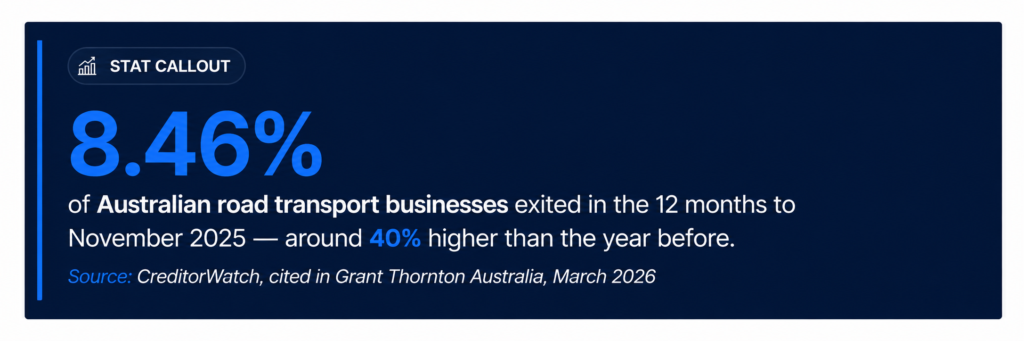
Insolvencies in the Transport, Postal and Warehousing sector more than doubled between FY2021-22 and FY2023-24 — from 196 to 495. ASIC figures show the sector is on track for another record year. Industry associations are reporting a race to the bottom on freight rates at the same time fuel, labour, and insurance costs continue to climb.
For operations managers and business owners inside logistics companies, the practical reality breaks down into four specific problems that show up every week:
Manual exception handling consuming senior time. Delivery exceptions, contract disputes, proof-of-delivery reconciliation, and invoice discrepancies are being handled manually by people who should be making operational decisions — not performing data entry.
No real-time visibility into what is happening. Decisions are being made from systems that update in batch cycles, not live. By the time a manager knows about a delay or a missed delivery, it has already happened.
Thin margins with no obvious cost lever. Fuel levies cannot be absorbed, wages cannot be cut, and freight rates are already at the floor in many corridors. The only lever left is operational efficiency — and most mid-market operators have not pulled it yet.
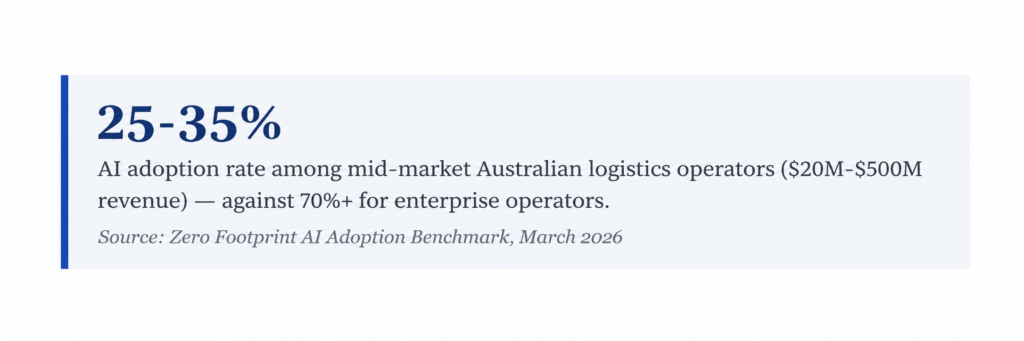
The mid-market represents the largest underserved segment. These operators have complex enough operations to benefit from AI but lack the internal capability or consulting budgets to implement it. The technology that enterprise operators built custom for $500,000 can now be replicated for a mid-market logistics company in 4 to 6 weeks at a fraction of that cost. That is what has changed in 2026.
What AI Automation Actually Looks Like in Australian Logistics
Before getting into specific automations, it is worth being clear about what AI automation means in practice for a logistics company. It is not a single platform that replaces everything. It is a series of specific workflow automations — each one targeting a high-volume manual process — that are built, tested, and handed over to run without human involvement.
The Australian market in 2026 is shifting from basic automation toward systemic intelligence, where AI serves as a core operating system. Systems are moving beyond simple alerts — autonomous agents now independently renegotiate freight rates and reroute shipments based on live port or road disruptions.
1. Exception Management and Client Notification
This is the highest-impact automation for most logistics operations — and the one that saves the most senior time.
The current manual version at most mid-market operators: a driver reports a delivery exception. An operations coordinator checks three systems to understand the impact. They WhatsApp the client. They update the TMS manually. They flag the exception to the account manager if there is a penalty clause. They log it in the reporting spreadsheet for the weekly review. Total time: 15 to 25 minutes per exception. At 20 exceptions per day, that is 4 to 8 hours of coordinator time daily — on a single task.
The automated version: a delivery exception is logged in the TMS. An AI agent checks the contract for penalty clause exposure, calculates the revised ETA, generates a personalised client notification via email or WhatsApp, flags any financial exposure to the accounts team, and updates the operations dashboard — all within 90 seconds. The coordinator receives only the exceptions that require a human judgment call.
2. Invoice Reconciliation and Payment Disputes
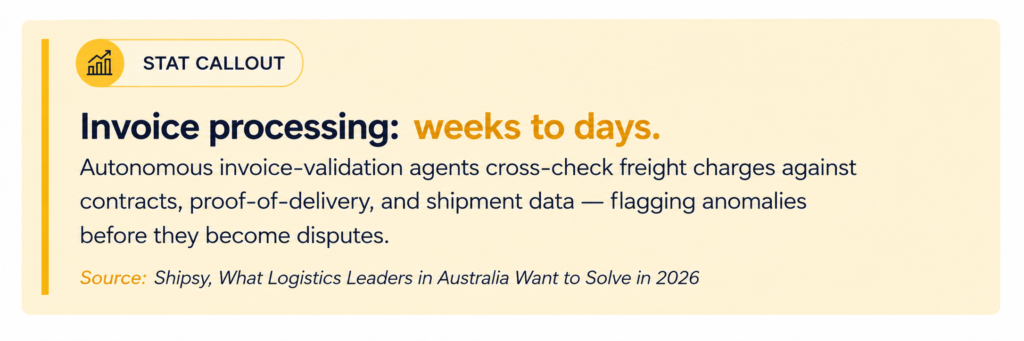
Freight invoice reconciliation is one of the most time-consuming back-office tasks in Australian logistics — and one of the most automatable. The process involves checking every freight charge against the agreed rate card, confirming the proof-of-delivery, identifying overcharges, and either raising a dispute or approving the invoice.
For a mid-size operator processing 200 to 400 invoices per week, this typically requires 2 to 3 people spending significant time on tasks that follow completely predictable rules. An AI agent handles the standard cases — matching invoices to contracts, flagging anomalies above a defined threshold, and routing genuine disputes to a human — while the team focuses only on exceptions that actually need judgment.
Typical outcome: invoice processing time reduced from 5 to 7 days to 1 to 2 days. Overcharge recovery increases because no anomaly is missed. Accounts payable team redirected to exception management rather than routine reconciliation.
3. Customer Communication and Delivery Updates
Customer demand for speed and self-service will continue to intensify in 2026. Australian logistics customers — particularly in e-commerce fulfilment and last-mile delivery — now expect proactive communication without having to ask for it.
A WhatsApp or email automation agent handles the entire standard communication flow: dispatch confirmation, in-transit updates at defined checkpoints, ETA adjustment notifications, delivery confirmation with a proof-of-delivery photo, and a follow-up satisfaction check 24 hours later. For operations teams managing hundreds of consignments daily, automating the standard communication flow entirely removes a category of work from the team’s day.
4. Operations Reporting and KPI Dashboards
The Friday afternoon operations report. The Monday morning KPI review. The end-of-month client performance summary. In most mid-market logistics companies, these reports are assembled manually — someone pulling data from the TMS, the driver app, the fuel card system, and the spreadsheet, combining them, formatting the result, and emailing it out. One to four hours of work per report, for information already sitting in systems.
A BI dashboard automation connects those systems, pulls the data on a schedule, and produces the report automatically — including a narrative summary if required. The manager opens their Monday morning with the report already in their inbox, generated from live data, not assembled the previous Friday afternoon.
5. Compliance Reporting — AASB S2 and Scope 3 Emissions
This is the most urgent automation need for Australian logistics in 2026, and the least addressed. The AASB S2 mandatory sustainability reporting requirements have brought Scope 3 emissions tracking into the compliance calendar for a growing number of operators. For logistics companies, Scope 3 represents 70 to 90% of total carbon footprint — covering subcontractors, fuel suppliers, and downstream transport.
Collecting this data manually across a network of subcontractors and carriers is an enormous administrative burden. An automation agent collects emissions data from connected systems, calculates Scope 3 emissions per consignment, flags outliers, and produces the required AASB S2 report format automatically. This is not a nice-to-have for logistics companies now subject to mandatory reporting thresholds — it is a compliance requirement with a deadline attached.
The ROI Case for Australian Logistics Automation
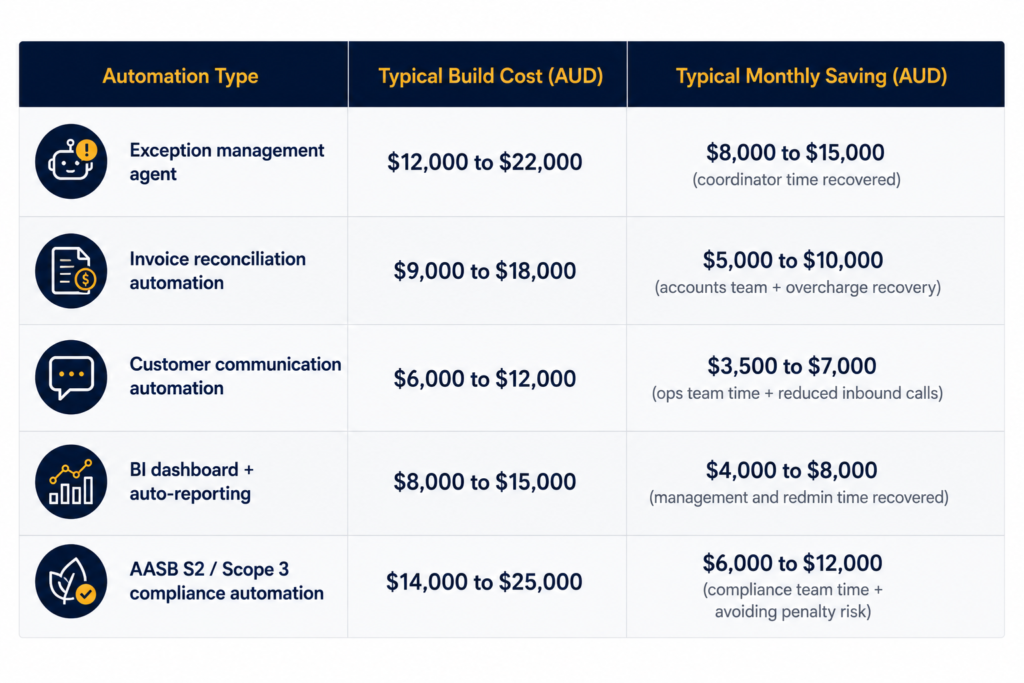
Every conversation about AI automation arrives at the same question: what does it actually cost, and does the saving justify it?
Here is a realistic calculation for a mid-size Australian logistics operator. All figures use ABS Labour Force median full-time earnings of $1,711 per week, equivalent to approximately $45 to $55 per hour for operational roles.
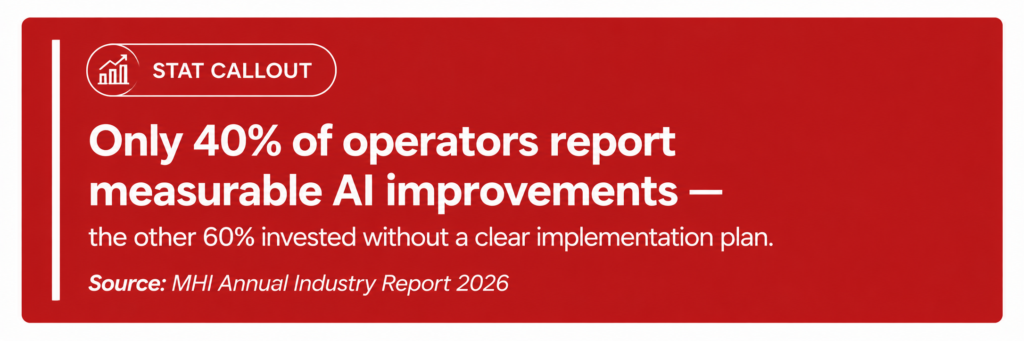
That statistic matters. The difference between the 40% who see measurable improvements and the 60% who do not is almost never about the technology. It is about whether the process was properly documented before automation started, whether a clear ROI metric was defined upfront, and whether there was one person accountable for the result after go-live. These are process discipline questions, not technology questions.
What Separates Australian Logistics Companies That Succeed With AI From Those That Don't
The businesses that get measurable results from AI automation in 2026 have three things in common. None of them are about which tool they used or which vendor they hired.
They documented the process before anyone built anything
Every step. Every decision point. Every exception. What triggers the process. What constitutes a correct output versus an incorrect one. What happens when the data is missing or wrong.
This sounds obvious. It is vanishingly rare in practice. Most logistics operations have processes that exist as institutional knowledge — everybody knows how it works, but nobody has written it down. The companies that succeed spend 3 to 5 days on documentation before a single hour of build time. The ones that fail skip this step to save time — and spend that time debugging the wrong thing six weeks later.
They defined what success looks like in numbers before the build started
Not “we want to be more efficient.” A specific metric: “our exception handling time per event will drop from 22 minutes to under 5 minutes” or “our invoice dispute rate will drop from 8% to under 2%.”
This number does two things. It gives the build team a specific target to design toward, and it gives the business a clear basis for evaluating whether the investment worked. Without a pre-agreed metric, every post-implementation conversation becomes subjective.
They ran the automation in parallel before cutting over
The single most effective risk management step in any logistics automation project is running the AI agent alongside the manual process for 2 to 3 weeks before switching over. The team continues to handle exceptions manually. The agent handles them automatically. At the end of each day, the outputs are compared.
If the discrepancy rate is below 2%, the team cuts over with confidence. If it is above 2%, the specific failing edge cases are identified and fixed before any client is affected. No disruption to operations. No client sees the seams. This approach adds 2 to 3 weeks to the timeline and eliminates the most common cause of AI automation failure in logistics.
How to Start: The Four Questions to Answer Before You Commission Anything
Which process does your team repeat more than 10 times a day, every day, following the same steps each time? That is your first automation candidate. Not the most exciting process — the most repetitive one. Repetition is the signal.
Can you write every step of that process on paper in under 30 minutes? If yes, you can automate it. If not, the documentation work has to happen before anything else.
What is the measurable outcome you want — and how would you know in 30 days whether the automation delivered it? Hours saved per week, error rate reduction, response time improvement, cost per transaction. Name the number before you start.
Who will own this automation after it goes live? One named person who will review the Day 7 performance report and escalate if something is wrong. Without an owner, even excellent automations drift toward disuse within a quarter.
If you can answer all four, you are ready to start a conversation with a build team. If you cannot yet answer one of them, that is where to put your time before any vendor conversation.
Talk to Wority — Free 30-Minute Scoping Call
Wority Technology builds custom AI automation for logistics and supply chain businesses in Australia, the UK, UAE, and India. We map your highest-volume manual process, build an agent to run it automatically, and hand you the complete source code on go-live day.
Fixed price. Delivered in 4 to 6 weeks. You own everything.
Recent logistics automation results:
Dubai logistics company: 66 hours per week of manual operations eliminated in 4 weeks
Gujarat manufacturer: 22 hours per week saved, payback in 6 weeks
UAE freight operator: 75% manual workflow reduction, £11,500 build cost

