In 2025, the business world talked about AI chatbots. In 2026, it is deploying AI agents. The difference is not semantic — it is fundamental.
A chatbot waits for you. An agent acts for you.
A chatbot answers questions. An agent monitors your systems, makes decisions, and executes multi-step tasks without being asked.
89% of CIOs now name agentic AI their number one strategic priority (Futurum Group, 2026). Gartner projects that 40% of enterprise applications will include task-specific AI agents by the end of this year. The demand is real, the technology is mature, and the ROI is measurable.
The problem: the supply side has not caught up with this for SMEs. Enterprise vendors build agentic AI at enterprise price points and on 12-month timelines. No-code tools can build simple automations but not the multi-system, decision-capable agents that deliver real operational transformation.
The SME market has a gap. And a growing number of vendors are claiming to fill it — most of whom have learned the vocabulary without mastering the craft.
This article is written for founders, CTOs, and operations leaders who are actively looking for an agentic AI development company and want to know how to tell the difference.
Building an AI agent is not the same as building a workflow automation. An agent observes, plans, decides, acts, and adapts. That requires a team that has built decision-logic systems before — not one that repurposed their chatbot practice.
What an Agentic AI Development Company Actually Builds
Before evaluating vendors, it helps to be precise about what agentic AI development means in 2026.
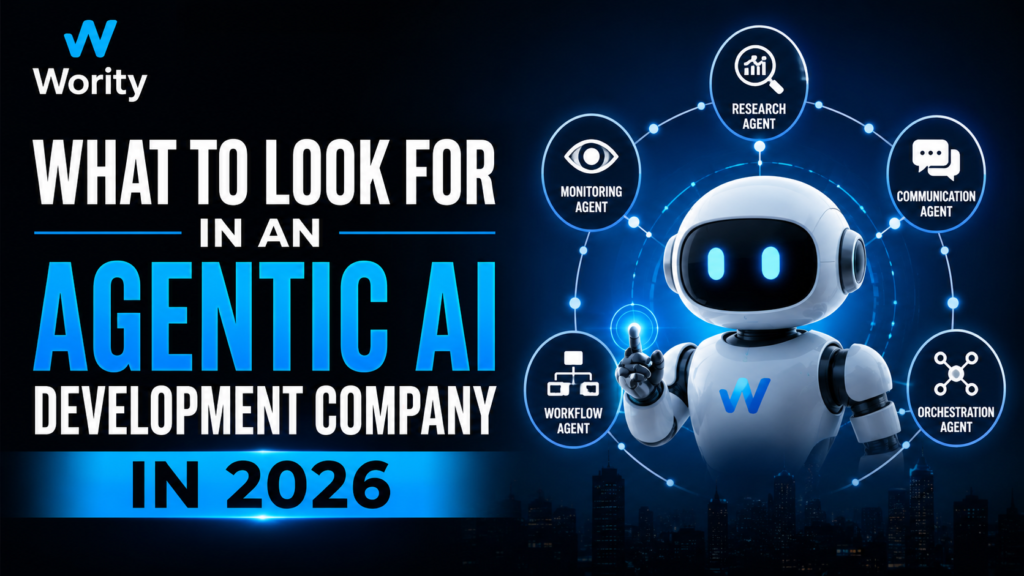
| Agent Type | What It Does | Differentiating Capability | Example Use Case |
|---|---|---|---|
Workflow Agent |
Executes a defined sequence of tasks from a single trigger |
Handles exception paths and escalates ambiguous cases |
Invoice received → matched → approved → paid → supplier notified |
Monitoring Agent |
Watches data continuously and acts when conditions change |
Initiates action without being told — proactive not reactive |
Inventory below threshold → PO raised → supplier alerted → manager notified |
Communication Agent |
Manages multi-turn conversations and takes actions based on intent |
Understands intent not keywords — handles variable inputs |
Voice call → intent understood → appointment booked → confirmation sent |
Orchestration Agent |
Coordinates multiple sub-agents to complete a complex goal |
Decomposes high-level goals into tasks across multiple systems |
“Onboard this new client” → contract, CRM, billing, and welcome agents all activated |
Research Agent |
Gathers and synthesises information from multiple sources |
Autonomous information gathering — no human search required |
“Research competitors in this market” → web crawl, synthesis, structured report |
The 7 Things That Distinguish a Credible Agentic AI Development Company
1. They Document the Process Before They Build the Agent
This is the single most reliable signal of a credible agentic AI partner. An AI agent is only as good as the process it is built to automate. A vendor who jumps straight to building without mapping your current workflow, documenting every decision point, and identifying every edge case is building on sand.
The most common reason AI agents fail in production is not the AI. It is an incompletely documented process.
Ask any prospective agentic AI development company: “What is your process mapping methodology?” If they cannot give you a specific answer — that is the answer.
2. They Design Human-in-the-Loop From the Start
Fully autonomous AI agents with no human oversight or escalation path are appropriate only for extremely well-defined, low-risk processes. Any credible agentic AI company designs human escalation paths from the first design session — not as an afterthought.
The question “What happens when the agent encounters something it cannot handle?” should have a specific, designed answer. Not “the AI will figure it out.”
3. They Can Show You Live Agent Deployments
Demonstrations of similar deployments for comparable clients. Not a polished demo of a perfect scenario — a real system handling real inputs, including edge cases and failure modes.
If a vendor can only show you slides and architecture diagrams, they have not deployed the number of agents their marketing implies.
4. They Have a Defined Testing Protocol
Agentic AI systems require layered testing: unit testing of each action, integration testing of the full chain, edge case testing, failure testing, and a parallel run alongside the manual process before production deployment.
A vendor without a specific testing protocol is one whose agents will fail in production and blame “unexpected inputs” rather than inadequate testing.
5. They Monitor Performance Post-Deployment
An AI agent deployed and abandoned is a liability. Agents encounter new edge cases as real-world inputs evolve. A credible agentic AI development company includes post-deployment monitoring as a standard part of their engagement — tracking trigger volumes, action success rates, error rates, and escalation frequency.
6. You Own Everything They Build
Source code, prompt files, workflow logic, API configurations, and documentation. If a vendor’s contract implies that their platform access is required to operate the agent, you do not own the agent — you are renting it.
This creates a dependency that is both expensive and risky. Insist on full ownership and transfer of all assets on project completion.
7. They Are Honest About What AI Cannot Do
The most trustworthy signal of a credible agentic AI development company is their willingness to tell you that a specific process is not ready for autonomous AI operation — or that a specific technology is overhyped for your particular use case.
Vendors who promise that AI can do everything, starting next week, have a financial incentive to oversell. The honest partner tells you what will work, what will not, and why — before you sign anything.
8 Questions to Ask Every Agentic AI Development Company
Use this list when evaluating any vendor:
1. “Walk me through exactly how you would map and document our process before building an agent. What does that session look like in practice?”
2. “How do you handle the situation where the agent encounters an input it has never seen before? Can you show me a specific example from a previous project?”
3. “What is your testing protocol before a live production deployment? What is the acceptable error rate and how do you measure it?”
4. “How do you monitor agent performance after deployment? What metrics do you track and at what frequency?”
5. “Can I see a screen recording or live demo of an agent you have deployed in a similar industry to ours?”
6. “What is included in the project price in terms of post-go-live support? What is explicitly not included?”
7. “When the project is complete, what exactly do I own? Where is the source code? Can I edit the agent without your involvement?”
8. “Tell me about a project where an agent did not perform as expected. What happened and what did you do?”
Use this list when evaluating any vendor:
1. “Walk me through exactly how you would map and document our process before building an agent. What does that session look like in practice?”
2. “How do you handle the situation where the agent encounters an input it has never seen before? Can you show me a specific example from a previous project?”
3. “What is your testing protocol before a live production deployment? What is the acceptable error rate and how do you measure it?”
4. “How do you monitor agent performance after deployment? What metrics do you track and at what frequency?”
5. “Can I see a screen recording or live demo of an agent you have deployed in a similar industry to ours?”
6. “What is included in the project price in terms of post-go-live support? What is explicitly not included?”
7. “When the project is complete, what exactly do I own? Where is the source code? Can I edit the agent without your involvement?”
8. “Tell me about a project where an agent did not perform as expected. What happened and what did you do?”
The Agentic AI Market in 2026 — Why the Window Is Open Right Now
The timing matters. Here is the market context:
→ AI Agents market growing from $7.84 billion in 2025 to $52.6 billion by 2030 at 46.3% CAGR (MarketsandMarkets, 2026)
→ 89% of CIOs name agentic AI their number one strategic priority for 2026 (Futurum Group)
→ Only 10% of businesses have scaled AI agents beyond pilots — the adoption gap is the opportunity
→ SME-accessible agentic AI builds are now available from £5,000–£18,000, down from £50,000+ three years ago
→ Fortune 500 companies using agentic AI have cut reporting cycles from 15 days to 35 minutes (McKinsey, 2026)
→ Healthcare AI agents: 42% documentation time reduction, 66 minutes per day freed per clinician (AHA, 2026)
The companies that deploy their first AI agent in 2026 will have 12–18 months of operational advantage over competitors who are still evaluating. That advantage compounds every quarter it is maintained.
What Wority Technology Builds as an Agentic AI Development Company
Wority Technology is an AI automation and agentic AI development company based in Gandhinagar, Gujarat, India — delivering for clients in the US, UAE, UK, and India.
We build all four types of AI agents: Workflow, Monitoring, Communication, and Orchestration. Every build follows our defined standard: documented workflow first, architecture design with client approval, layered build process, parallel testing before production, and 30 days of monitored performance review post-deployment.
Our clients are SMEs — businesses with 20 to 500 employees who have real operational problems and limited appetite for 12-month enterprise timelines. Our typical agentic AI project delivers a working first agent in 4–6 weeks.
We do not have a proprietary platform that locks you in. We do not use “agentic AI” as a buzzword to dress up simple automation. And we will tell you honestly if a process is not ready to be agentified — because the alternative is a project that fails and a client who associates AI agents with wasted money.
Explore Agentic AI for Your Business
Wority Technology delivers AI agents for SMEs in the US, UAE, UK, and India.
Typical first agent: £5,000–£18,000. Delivered in 4–6 weeks. You own everything.
Book a free 30-minute scoping call to identify your first agent opportunity and receive an honest estimate.
→ woritytechnology.com/contact
→ hello@woritytechnology.com
