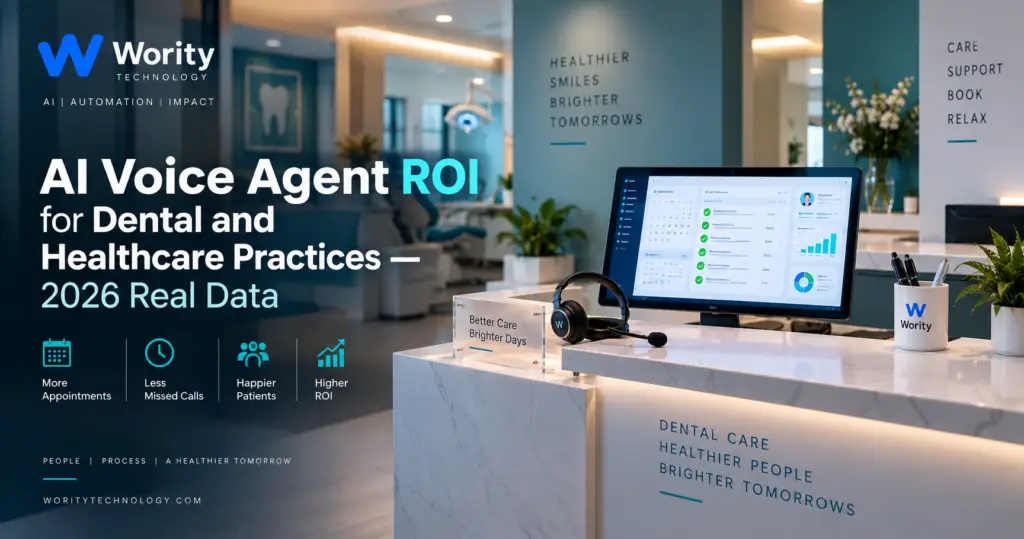
The Missed Call Revenue Problem — Why It Is Bigger Than Most Practices Realise
For dental practices and healthcare clinics, phone calls are not just communication — they are revenue. Every call that goes unanswered is a potential patient that calls the next practice within ten minutes.
The data from 2026 is clear and specific:
38% of dental practice calls go unanswered during business hours. Of those missed calls, 85% of callers do not leave a voicemail. They call the next practice on their search results. (Peerlogic 2026, tracking 4,280 calls across 26 practices.)
Practices using AI to handle calls recover an average of $47,000 per location annually in missed-call and missed-message revenue. (Peerlogic 2026.)
AI voice costs approximately $0.10 per call answered versus $1.38–$1.60 for a human answering service. (Brilo AI 2026.)
This post covers how voice AI works for healthcare practices, the compliance requirements (HIPAA in the US, CQC and NHS Data Standards in the UK), how the ROI calculation works for your specific practice, and what a realistic implementation looks like.
Most practice managers think about missed calls in terms of inconvenience — the patient has to call back later. The revenue picture is significantly larger.
The immediate revenue per missed new patient call:
– Average first-visit fee (UK dental, NHS): £25.60 (Band 1 treatment)
– Average first-visit fee (UK dental, private): £80–£400 depending on practice
– Average first-visit fee (US dental): $200–$500 depending on specialty
The lifetime patient value:
– UK NHS dental patient: £150–£500 over typical relationship
– UK private dental patient: £2,000–£15,000 over typical relationship
– US dental patient: $5,000–$15,000+ lifetime
– GP practice (UK, NHS): value is indirect — patient registration quality and QOF achievement
For a private UK dental practice receiving 200 calls per month, missing 38% (76 calls) with a 25% conversion rate on answered calls means missing approximately 19 new patients per month. At an average private first-visit value of £150, that is £2,850 per month in immediate missed revenue — £34,200 per year — before accounting for any lifetime value.
What Voice AI Actually Does in a Healthcare Practice
A 2026 voice AI agent for a dental or medical practice handles:
Inbound call answering: Every call answered in two rings, 24/7. The agent identifies itself as automated at the start (“Hi, you’ve reached [Practice]. This is our automated booking assistant — I can help with appointments. Press 0 at any time to speak with our team.”). EU AI Act and UK GDPR-compliant disclosure is built in.
Appointment booking: Checks real-time availability in your practice management system (Dentrix, Carestream, EMIS, SystmOne, etc.), offers available slots, confirms the booking, updates the PMS record, sends an SMS/WhatsApp confirmation to the patient.
FAQ handling: Answers questions about services, pricing, insurance accepted, opening hours, location, and preparation instructions for specific treatments. Responses are drawn from the practice’s specific information — not generic answers.
After-hours message capture: For calls arriving outside operating hours, the agent captures the patient’s name, contact details, and reason for calling in a structured log delivered to the practice manager first thing in the morning.
Urgent call routing: Any caller describing an emergency (dental pain, chest pain, acute symptoms) is immediately transferred to an emergency number or provided emergency contact information. This escalation is non-negotiable and built into every healthcare voice AI Wority delivers.
Outbound call capability (optional): Some deployments include the agent making outbound calls for appointment reminders, missed appointment follow-up, and recall campaigns.
Compliance — HIPAA (US), CQC (UK), GDPR (UK/EU)
Healthcare is the highest-scrutiny compliance environment for AI automation. Getting this wrong is not just a fine risk — it is a patient safety and practice reputation risk.
US — HIPAA: Any voice AI system that handles Protected Health Information (PHI) must be built on HIPAA-compliant infrastructure. This requires: a Business Associate Agreement (BAA) signed with every vendor whose systems touch PHI, encrypted data storage and transmission, access controls limiting PHI access to authorised parties, and audit logging of all data access and modifications. Wority includes HIPAA compliance architecture and BAA coordination in every US healthcare project.
UK — CQC and NHS Data Standards: UK dental practices and GP surgeries handling patient data through automated systems must comply with CQC standards on information governance, NHS DSPT (Data Security and Protection Toolkit), and UK GDPR. Any AI system that processes patient calls must maintain appropriate security standards and enable subject access requests.
EU AI Act (UK businesses serving EU patients): If your practice has EU-based patients, Article 50 disclosure obligations apply to any AI-powered patient communication.
Patient consent for automated communications: Standard patient registration forms should cover consent for automated appointment reminders and confirmations. Confirm your consent language covers AI-powered communications before deployment.
The ROI Calculation for Your Practice
Step 1: Your current monthly call volume.
Step 2: Multiply by 38% (the industry average missed call rate during business hours).
Step 3: Estimate your conversion rate on answered new patient calls (typically 20–35%).
Step 4: Multiply by your average first-visit fee.
Step 5: That is your monthly missed revenue from calls alone.
Step 6: Compare to voice AI deployment cost.
UK example — private dental practice:
300 monthly calls × 38% missed = 114 missed calls
114 × 25% conversion = 28 additional new patients if all calls answered
28 × £120 average private first-visit = £3,360/month immediate revenue
Voice AI cost: £3,500 build + £180/month running cost
Payback: approximately 4–5 weeks from go-live
US example — dental practice:
400 monthly calls × 38% missed = 152 missed calls
152 × 25% conversion = 38 additional new patients
38 × $250 average first-visit = $9,500/month
Voice AI: $5,000 build + $250/month platform
Payback: approximately 2–3 weeks
What Voice AI Cannot Do in Healthcare — The Honest Limits
Clinical triage and medical advice: Voice AI must never make or suggest clinical decisions. The agent handles administrative and booking functions only. Any clinical question is transferred to a clinician.
Mental health crisis calls: Any caller showing signs of distress or mental health crisis must be immediately transferred to a human or directed to emergency services. This escalation must be built in from the design stage and tested explicitly before go-live.
Complex insurance and billing disputes: Multi-step insurance negotiations requiring policy interpretation need human involvement. Standard billing queries (balance, payment methods, next due date) are automatable.
Implementation Timeline for a Single-Location Practice
Week 1: Discovery — call flow design, FAQ content gathering, PMS integration scoping, compliance architecture review.
Week 2–3: Build — agent configuration, PMS integration, disclosure language, escalation paths.
Week 4: Testing — 50+ test calls across all scenario types including emergencies.
Week 5: Soft launch — agent handles after-hours calls only. Compare outcomes to baseline.
Week 6: Full cutover — agent handles all inbound calls. Team monitors for the first week.
Q1: How much revenue does a dental practice actually recover with voice AI?
Q2: Is AI voice safe for healthcare — does it handle emergencies correctly?
Q3: Is voice AI HIPAA compliant?
Q4: Will patients know they are speaking with an AI?
Want to know exactly how many calls your practice is missing and what the revenue impact is?
Book a free 30-minute scoping call. We will calculate the missed call revenue for your specific practice and give you a fixed implementation quote.
Book a free 30-minute scoping call